Oktoberfest, the world’s largest folk festival, began as a wedding party. In 1810, Munich threw a celebration for a royal bride and groom, and the festival that grew from it still shapes how Alpine brides dress today.
The wedding that started Oktoberfest
The first Oktoberfest was held in 1810 to celebrate the wedding of Crown Prince Ludwig of Bavaria, later King Ludwig I, to Therese of Saxe-Hildburghausen. The citizens of Munich were invited to join the festivities.
There was one telling detail. The guests were supplied with French clothes, because their own folk costumes were not considered suitable for public occasions. French fashion had spread across Europe, and rural dress was seen as too rustic for a royal celebration.
How folk dress went from rustic to royal favorite
Within a few decades, the mood had completely flipped. In 1835, Oktoberfest featured a parade of traditional costumes to celebrate the silver wedding anniversary of Ludwig I and Therese, the same couple, 25 years on.
Bavarian and Austrian courts had grown enthusiastic about the rural costumes of their people, and associations devoted to wearing them were founded from 1859 onward. In 1910, the Wallach brothers, Munich businessmen who promoted Alpine dress, organized and paid for the costume parade for Oktoberfest’s 100th anniversary.
What a wedding dirndl looks like
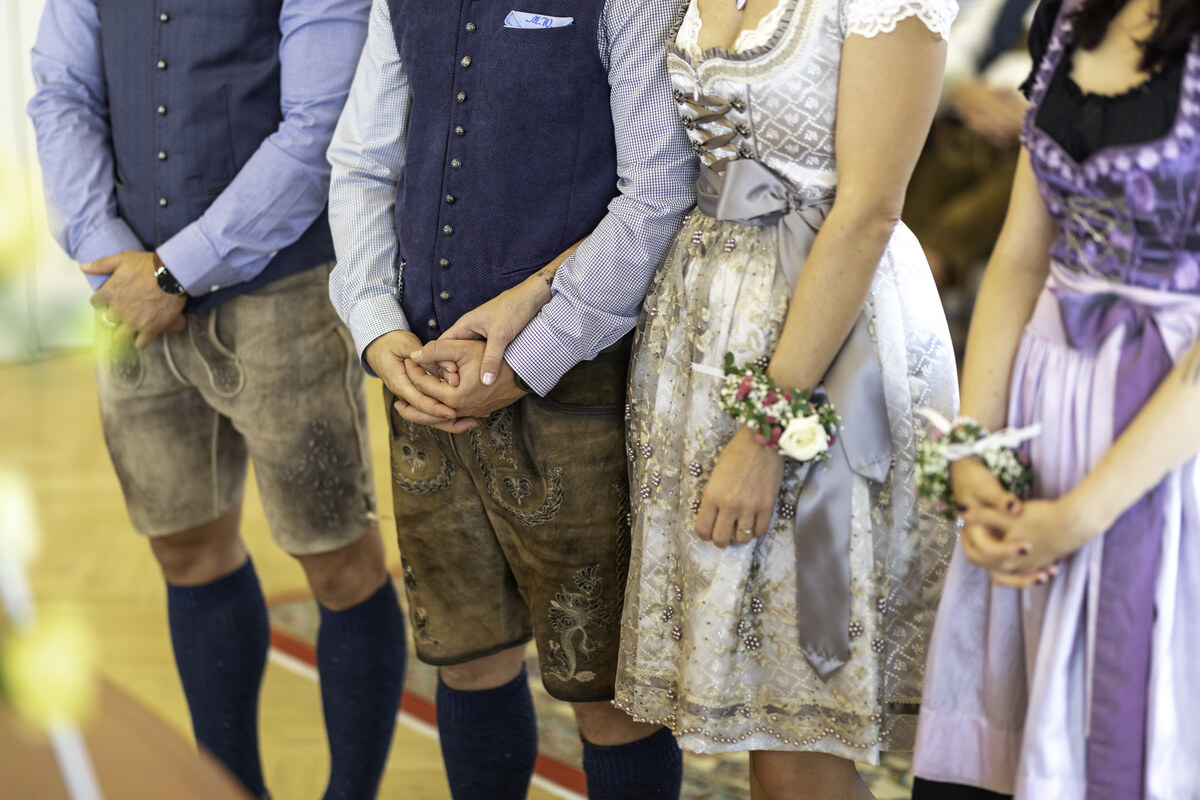
The dirndl is a dress from the German-speaking Alps, made of a fitted bodice, a blouse, a full skirt and an apron. Its name is a diminutive of Dirn, a word that originally meant “young woman.”
A wedding dirndl is the ceremonial version, worn by brides in Alpine regions of Germany, Austria and South Tyrol. There was no standardized bridal gown. Traditionally, a bride wore her finest festive dirndl, adapted to local custom.
These dresses are usually made of finer fabrics than everyday versions, such as silk, fine cotton, velvet or linen. Formal touches include lace or long-sleeved blouses, decorative aprons in silk or organza, and jewelry such as chokers or brooches.
Not always white
Here is a surprise for anyone picturing a bride in white. Colors varied by region and period, and they were never limited to white. Ivory, cream and pastel shades are common in modern wedding dirndls, but darker colors were historically worn in some areas, particularly for winter weddings.
The festive dirndls of the past could also be richly decorated, with embroidery, floral touches, tassels and lace collars draped over the shoulders. Details could signal the wearer’s home region and social standing, and elaborate headwear such as the Goldhaube marked status as well.
A tradition that never really left
After the Second World War, the dirndl lost ground in many cities. Even so, many people kept wearing it for festive occasions, and it remained especially popular as a bridal dress.
In Alpine areas, folk costume is still worn for most weddings and festivals. In South Tyrol, the Country Wedding in Kastelruth is one of the public events where folk costume takes center stage.
Today, wedding dirndls range from historically accurate reproductions of regional dress to modern interpretations that keep the traditional structure but add contemporary design details.
An idea for your own wedding
You do not need to marry in the Alps to borrow the spirit. If your family has a regional costume, a favorite festive outfit or a heritage fabric, the dirndl story shows that a bride’s best dress has often been the one that says where she comes from, not one single gown everyone agreed on.