At many Scottish weddings, the groom, his groomsmen and a good share of the guests arrive in kilts. It looks like a tradition as old as the Highlands themselves, yet the kilt in its modern form is usually traced back to an English Quaker in the 1720s.
From a great wrap of cloth to a pleated skirt
The kilt was first recorded in the 16th century as the great kilt, also called the belted plaid. It was a full-length garment, and its upper half could be thrown over the shoulder like a cloak or pulled up over the head.
The smaller version, the one that looks like the kilt we know today, is credited to Thomas Rawlinson, a Quaker from Lancashire in England. He found the belted plaid “cumbrous and unwieldy”, so he separated the skirt and turned it into a garment of its own, with the pleats already sewn in.
His associate Iain MacDonnell, chief of the MacDonnells of Inverness, began wearing it too. Clansmen working in logging, charcoal making and iron smelting saw their chief in the new garment and followed, and it spread “in the shortest space” across the Highlands. It has also been suggested that a small kilt with unsewn pleats was already being made in the 1690s, so the story may not be quite as tidy as it sounds.
Even the word has a modest origin. To kilt originally meant to tuck up your skirts around the body, a verb that appears to come from Scandinavia.
Clan tartans are younger than most people think
It is easy to assume a wedding kilt must be in the groom’s clan tartan. In fact, linking particular patterns to particular clans can only be traced back perhaps one or two centuries. It was during the Victorian era that named tartans were systematically recorded, mostly by weaving companies for commercial reasons. Before that, Highland tartans were tied to regions rather than to families.
That leaves plenty of room to choose. Around 3,500 tartans were registered in the Scottish Tartans Authority database in 2004, and each can be woven in four colour variations (ancient, modern, weathered and muted), which adds up to about 14,000 options. There are tartans for districts, schools, companies and individuals, as well as generic patterns that anybody can wear. In modern Highland dress, a tartan is actually more often chosen for its look than for family ties.
Women traditionally do not wear the kilt itself. Instead, they may wear a long tartan skirt or a tartan sash, in the tartan of their birth clan or, if they wish, that of their spouse’s clan.
You do not need Scottish roots to wear one
Today most Scots see the kilt as formal or national dress, and it is usually owned or hired for weddings and other special occasions. It may be worn by anyone, whatever their nationality or descent. At Scottish weddings, kilts and full Highland dress are often rented, and suits are worn as well.
The strict rules some people quote are also fairly recent. The codes for proper formal Highland dress were settled in the Victorian era, with jackets modelled on the military doublets of Highland regiments. Scottish historian Hugh Cheape described these conventions in 2012 as “relatively recently formed”.
A few touches belong especially to the wedding day. A full plaid or fly plaid draped over the shoulder is usually kept for very formal events or for the groom himself. A sprig of white heather is often worn as a buttonhole for good luck, and the newlyweds frequently leave the ceremony to the sound of bagpipes.
Choosing the right look for your wedding
If your wedding is during the day, the Highland version of morning dress pairs the kilt with an Argyll, Crail or Braemar jacket in black, charcoal or tweed, a white shirt with a turndown collar, a long tie and black brogues. White and off-white hose are best avoided.
For an evening celebration, a Prince Charlie or Argyll jacket with a black bow tie gives the semi-formal black tie look, which is increasingly common. The most formal white tie version calls for a doublet, with velvet considered the dressiest fabric.
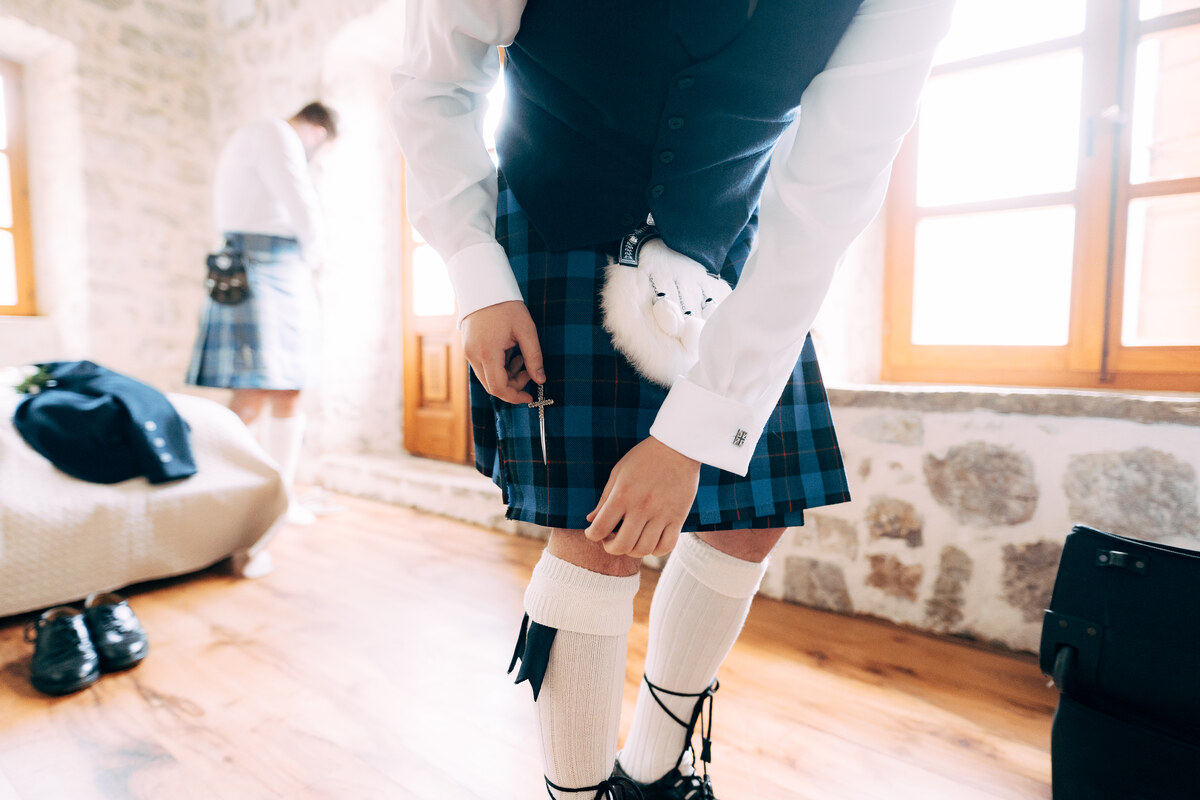
Whatever the style, the kilt should end no lower than halfway across the kneecap and no higher than about an inch above it. Kilt hose are turned down at the knee, and the sporran, a word meaning purse in Gaelic, hangs at the front. One last practical note: the small sgian-dubh knife tucked in the sock is typically not allowed on commercial flights, and it is sometimes replaced by a wooden or plastic version, or left out altogether. Worth remembering if you are flying to your wedding.