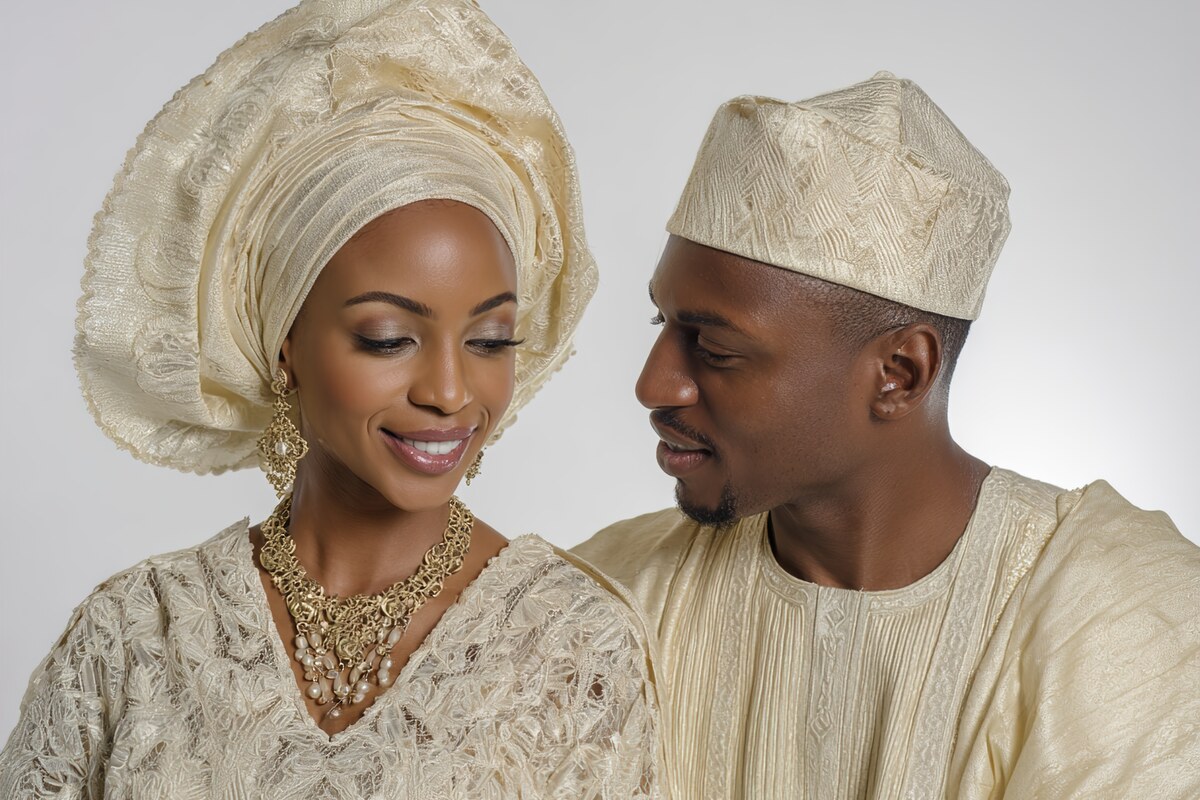
At a Yoruba wedding in Nigeria, a whole crowd of friends and relatives may turn up in the same fabric. The custom is called aso ebi, a Yoruba phrase that literally means “family cloth”.
It is a matching outfit, worn by the bride’s friends, the groom’s friends, the bridesmaids and groomsmen, both families and even guests. The idea behind it is simple and rather moving: when a friend’s support goes far enough, they are treated as family.
A friendship so close it counts as kinship
Aso ebi grew out of a Yoruba principle called Alajobi, the bond of kinship. A well-known saying captures it: “Ore bi omo iya”, which translates as a friend like maternal kindred.
The word itself is easy to unpack. Aṣọ means cloth and ẹbí means family group. Wearing the same fabric is a visible way of saying “we belong together” in a room full of people.
Weddings are one major setting, and the dress code also appears at funerals, birthdays and anniversaries. It can also mark age mates or members of a social club, who dress alike as a group.
When did the matching start?
Historians do not fully agree. Nigerian economic historian Ayodele Olukoju believes aso ebi became a novelty around 1920, during an economic boom after the First World War, when prices for products such as oil palm were high.
William Bascom traced the habit further back, to Yoruba age-grade groups who wore uniform dress to mark their fraternal bonds.
By the 1950s, women’s organizations known as egbes were turning up to relatives’ ceremonies and anniversaries in the same style of dress, sandals, wrapper, smock or necklace. Between the mid-1960s and the late 1970s, imported lace and “george” fabric joined the mix and became popular choices.
Fabric with a story: aso oke
Yoruba people wear aso oke at weddings and other special occasions. It is a hand-woven cloth whose name means “cloth from the hinterland”, woven in narrow strips, mostly by men on a horizontal loom, while women weave on vertical looms.
The patterns are not random. Colors and designs reflect Yoruba beliefs and daily life and are often passed down within families. A few classics are worth knowing:
- Sanyan: woven with wild silk in tan, cream or brown. In ancient times it was the most expensive of all Yoruba woven fabrics.
- Alaari: a deep red, crimson or purple background striped with other colors, with threads dyed in camwood.
- Etu: dark indigo with thin pale stripes, named after the guinea fowl.
Traditional Yoruba women’s dress usually includes a blouse (buba), a wrap skirt (iro), a head tie (gele) and a shoulder sash (ipele). Aso oke is only one option, though. Lace, Ankara and damask are also common.
Friendly rivalry, and a way to join in
Matching outfits can turn into a gentle competition. Groups try to outshine one another in quality, originality and richness of their uniform, and the outfit can signal how well-off someone is.
Fashion magazines in Lagos played a role too. Tailors looked to them for ideas, and their customers bought them to see whether they or their friends had been photographed.
Not everyone has the budget for a full ensemble, and the practice has a flexible side. Some guests add only a matching top or head covering. Textile dealers even offer advice and bulk rates for the fabric.
A custom that has traveled
Aso ebi is now largely a city phenomenon, and it has spread to other West African cultures. In Sierra Leone and Cameroon it is known as Ashobi, often by people who are unaware of its Yoruba roots.
Aso oke has traveled too. Designer Kenneth Ize has taken it to international runways, with suits worn by models Naomi Campbell and Imaan Hammam.
What to take from it
If you are planning a wedding, aso ebi offers a lovely idea: a dress code can be about belonging, not just looks. Choosing a shared fabric for the people closest to you is a way of saying that friends who show up are family.
If you are invited to one, those who wear the aso ebi are said to receive special recognition at the event.