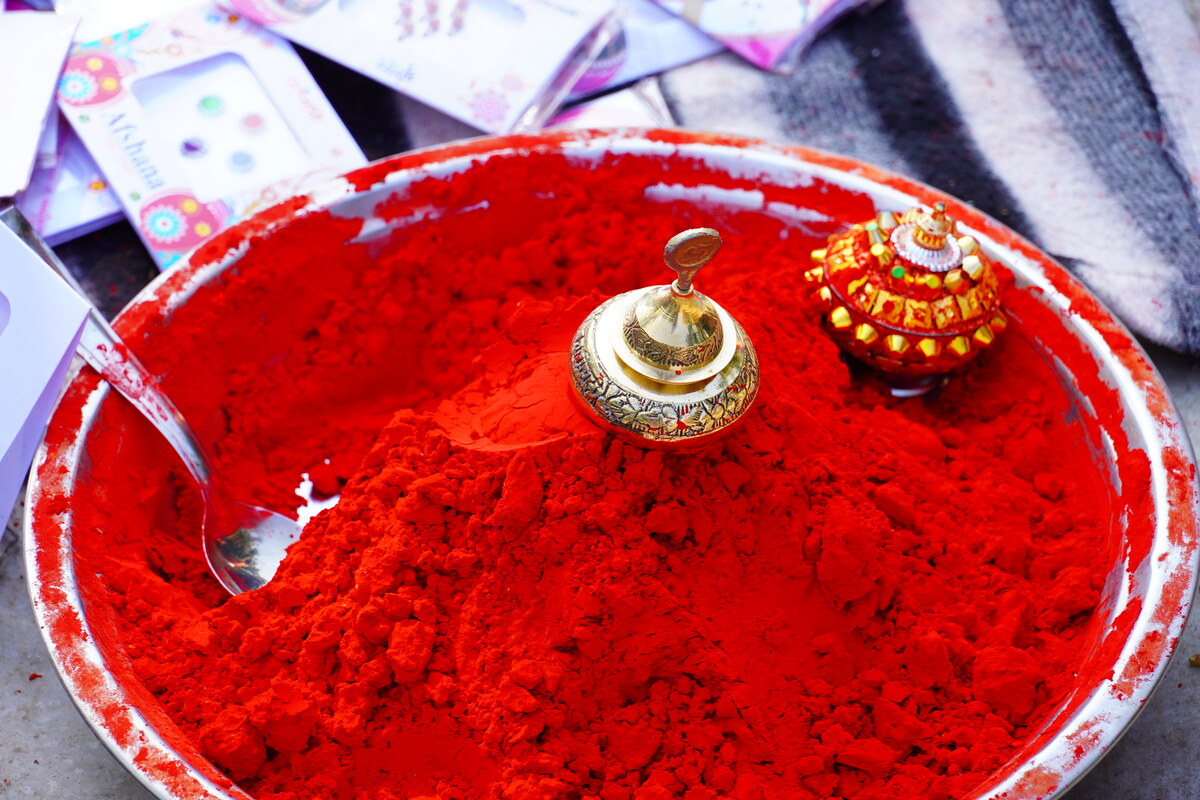
The bright red powder in a Hindu bride’s hair parting is called sindoor, and in its traditional form it is made from nothing more exotic than turmeric and lime. Mixed together, the golden spice and the white mineral turn a vivid red, which is one of the quiet bits of kitchen chemistry behind a famous wedding custom.
How yellow turmeric becomes red sindoor
Traditional sindoor is prepared by mixing turmeric (Curcuma longa) with slaked lime and alum. The alkaline lime reacts with curcumin, the compound that gives turmeric its colour, and the powder shifts from yellow to a bold orange-red. The old method used herbal ingredients that are safe for skin, which is part of why the recipe lasted for so long.
Over time, many makers moved to vermilion, a pigment ground from the mineral cinnabar, because it gave an even more intense red. That brought a new concern, since cinnabar contains mercury.
The moment the groom applies it
Sindoor is worn along the centre parting of the hair, known as the maang. At a Hindu wedding, the groom applies it for the first time in a ritual called sindoor daan, which marks the step from unmarried to married life. After that, the bride applies it herself, and many women keep up the habit daily.
How it is worn varies a lot. New brides often fill the whole parting, while other married women may use just a small touch at the start of the hairline. Younger women today sometimes wear it lightly, even with Western outfits, and among Hindu families in the United States and the United Kingdom it is often a personal choice rather than a rule.
A tradition that is younger than you might expect
Many people assume sindoor goes back to the earliest Hindu scriptures, but scholars note that it does not appear in the Vedas or the household ritual texts known as the Grihya Sutras. Its first verifiable mention is in the Puranas, in the Brahmanda Purana, which dates to roughly the 5th to 10th century CE. There, the dust at the feet of the goddess Lalita is compared to the vermilion on a parting of hair.
Older hints exist too. Terracotta female figurines from the Indus Valley, around 2500 BCE, and from Neolithic Mehrgarh show traces of red on the hair parting, which suggests a much older habit of colouring that spot.
A custom with a few surprises
Sindoor is usually linked to Hindu wives, yet it is not limited to them. Jain women apply it too, mostly in cities, and in several local cultures unmarried women wear it as well. In South India, a similar red powder called kumkum plays a related role and is considered a separate custom.
Then there is the folktale told about the Ramayana. Sita is said to have applied sindoor so that Rama would live a long life, and when Hanuman heard why, he covered his whole body in it to wish Rama even more of that blessing.
What to know before you buy it
This is the practical part for anyone planning a wedding with this ritual. Many modern, mass-made sindoors use red lead or industrial dyes, and in 2008 the U.S. Food and Drug Administration recalled batches from several manufacturers over high lead content.
The good news is that herbal versions made from hibiscus, marigold and red sandalwood have been on the market since the early 2000s. Quality checks vary from one brand to another, so it is worth asking where your sindoor comes from and what is in it, especially for something that will touch your skin and hair on your wedding day.
It is a small pinch of powder with a long story, and knowing the turmeric-and-lime recipe behind it makes the moment feel even more special.