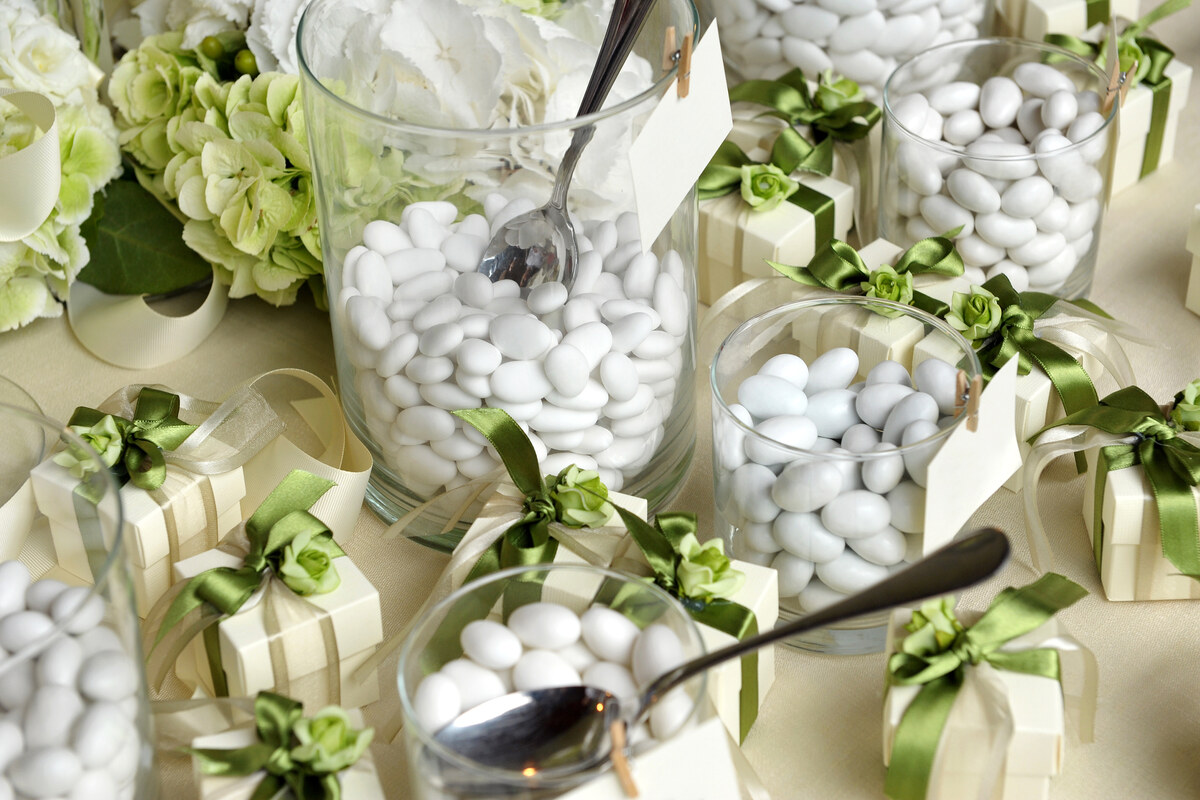
If you have ever opened a little wedding favor box and found exactly five pastel sugared almonds inside, that number was not a random choice. Each almond traditionally stands for a wish for the newlyweds: fertility, longevity, wealth, health and happiness.
It is one of the sweetest details of a wedding reception, and the story behind it stretches from Roman banquet tables to the jeweled boxes of European aristocrats.
From jeweled boxes to a handful of almonds
Thanking guests with a small gift is a very old idea. In the Graeco-Roman world, hosts already offered food or flowers to the people who attended their celebrations. In the Middle Ages, elaborate table decorations were sometimes given to important guests once the party was over.
The first true wedding favor is believed to be the bonbonniere, a small trinket box made of crystal, porcelain or even precious stones. It was common among European aristocrats and usually held sugar cubes or delicate confections, a quiet way of signaling wealth and royalty.
As sugar became more affordable, the precious boxes gave way to something simpler: almonds. For centuries, almonds were handed out to wedding guests as a way of sending good wishes to the couple for their new life together.
Why the almonds are coated in sugar
The idea of pairing almonds with something sweet may go back to ancient Rome, where honey-covered almonds were eaten. A charming legend, never verified but often repeated, credits a Roman confectioner named Julius Dragatus with serving these honeyed almonds, called dragati, at weddings and births.
Almonds coated with sugar, known as confetti, were introduced in the thirteenth century. When sugar became more widely available in the fifteenth century, coating nuts in sugar rather than honey became the norm. Sugared almonds are also linked to a Greek tale about Demophon, a king of Athens whose wife, the story goes, was reborn as an almond tree.
The symbolism is lovely once you know it. The bitterness of the almond and the sweetness of its coating are meant to mirror the bittersweet nature of marriage itself, a gentle reminder that a shared life holds both.
Today these candies are usually called Jordan almonds. The name most likely comes from a corruption of the French word jardin, meaning garden, to describe a cultivated rather than wild almond. Others link it to almonds grown along the Jordan River, or to the French town of Verdun, famous for its dragées.
How the rest of the world says thank you
The number matters in several countries. In Italy and Greece, sugared almonds are often given in odd numbers, to represent a marriage that cannot be divided, or in sets of five for the five wishes. Dutch couples hand out five pieces of bruidssuikers, or bridal sweets, wrapped in little tulle bags.
Elsewhere, favors take a completely different form:
- At Malaysian weddings, guests may receive hand-painted eggs, a symbol of fertility.
- In Japan, favors can include flowers, small bottles of sake and sweets.
- Puerto Rican guests often take home a decorated card, called a copia, listing the wedding date and the names of the couple.
- At some Scottish weddings, small inedible favours are attached to the cake and handed out by the bride herself.
Even the wedding cake belongs to this family of customs. Sharing it with guests is itself a form of gifting food to wish everyone a good and prosperous life.
Choosing favors for your own wedding
In the United States and Canada, favors have become a regular part of reception planning. The classics are still sugared almonds and individual chocolates, alongside candles and scented soaps. More modern couples choose personalized gifts with their names, initials or wedding date, or make a charitable donation in their guests’ names.
If you are deciding what to offer, four practical questions will do most of the work: your budget, your number of guests, how long the favor will keep (anything edible or fresh flowers will not last forever), and how much time you have to make or shop for them. You can hand each favor to guests, place it at every table setting, or even turn it into a small prize during the evening.
And if you love a nod to tradition, five sugared almonds in a pretty box remain one of the simplest ways to wish your guests, and yourselves, a sweet life ahead.