A Shinto wedding feels timeless, with its priest, its shrine maiden and its three cups of sake. Yet the ceremony as couples know it today only took shape around 1900, and the first mention of a wedding in a Shinto manual dates from 1872.
A tradition that is younger than it looks
Shinzen kekkon, literally “marriage before the kami,” began in Japan in the early 20th century. Earlier Shinto weddings were family gatherings without religious significance, apart from the occasional appearance of female dancers said to protect the bride from demons.
Weddings were not reported in Shinto settings until the 1880s, and at first they were limited to the families of Shinto priests. Scholars suggest the shift was driven by the decline of state-sponsored shrines in that decade, when a rash of new ceremonies appeared, including visits for newborns and on certain birthdays.
The royal wedding that set the pattern
The ceremony was popularized after Prince Yoshihito married Kujo Sadako in a Shinto ceremony at the Imperial Palace in 1900. It reflected a change in Meiji-era thinking, when marriage was legally recognized as a more balanced partnership between husband and wife.
The next one took place at Tokyo’s Hibiya Daijingu shrine in 1901. At first these weddings stayed in Tokyo and among the elite, then spread to Osaka and Kyoto. After 1945, when Shinto lost its status as a state religion, they became far more common, as families moved into smaller city homes and a commercial wedding industry grew up around shared venues.
Three cups, three pours, three sips
The heart of the ceremony is san-san-ku-do, or “three-three-nine-times.” Three cups of increasing size are each poured three times and swallowed in three sips. The groom drinks first from the smallest cup and offers it to the bride. On the second round the bride goes first, and on the third the groom begins again.
Nobody is sure where the ritual comes from. It may have started at samurai weddings, but the symbolism of the numbers has no clear origin. Some see it as sharing joys and sorrows. Others note that san-san sounds like “birth after birth,” a hint of fertility, while still others read it as man, woman and child, or heaven, earth and humankind.
What the ceremony looks like
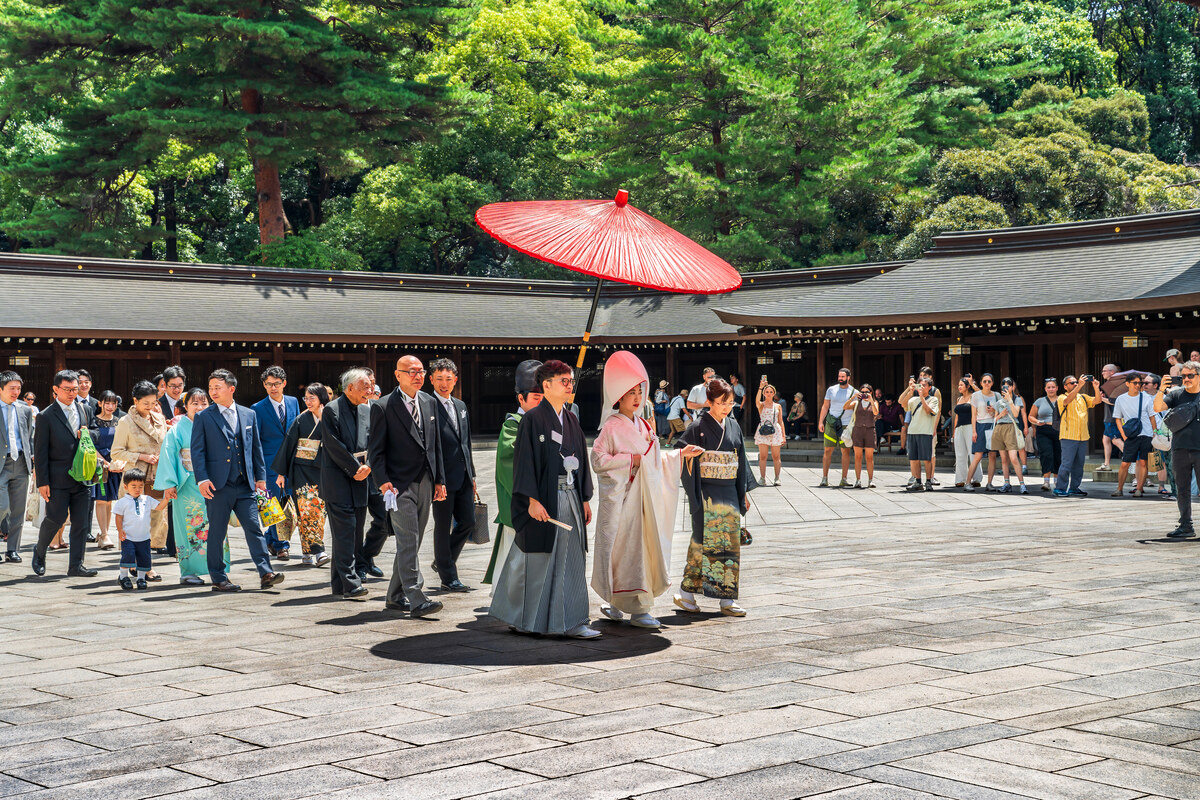
The whole ritual usually lasts only 20 to 30 minutes and is small, limited to close family, while the reception welcomes a larger group of friends. A priest stands to the right of the altar and a shrine maiden, a miko, to the left. Offerings of salt, water, rice, sake, fruit and vegetables sit on the altar, along with the wedding rings.
The groom reads the vows while the bride listens. A nakodo, or matchmaker, is thanked in them, a reminder of Japan’s history of arranged marriage. If there is no matchmaker, a friend or relative stands in. Families then drink sake together and call out kanpai.
The bride’s layers
Brides typically wear kimono, either a colorful uchikake or a pure white shiromuku, a word meaning “white pure-innocence.” Many rent the outfit, since a new formal kimono is costly, and some wear one passed down through the family. A bride may change into a red kimono for the reception, said to bring good luck.
A ritual that is quietly fading
Shinto weddings have dropped from 90 percent of ceremonies to about 50 percent since the 1990s, as fewer people marry and many choose a Western-style white wedding instead. Still, the sake cups remain a lovely reminder that even a tradition that feels ancient can be a living, recent invention, one that couples keep making their own.