Of all the quiet moments in a wedding ceremony, few feel as timeless as two flames joining into one. Yet the unity candle is a surprisingly modern idea, and a 1981 episode of the soap opera General Hospital may have helped bring it into so many ceremonies.
A young tradition with a gentle meaning
A unity candle is simply a candle used during the wedding ceremony to symbolize two people joining in marriage. The image is so natural that it is easy to assume it reaches back centuries.
In fact, there is no record of it in the Bible or in any apostolic writings. The custom first became popular in the second half of the 20th century, in American Protestant weddings.
Its exact origins remain unclear. One detail often noted is that a unity candle appeared in a 1981 episode of General Hospital, and that television moment may have helped the practice spread to real couples.
How the candle lighting usually works
In its most common form, the ritual begins with the families. The mother of the bride and the mother of the groom each light a taper candle, one for each family.
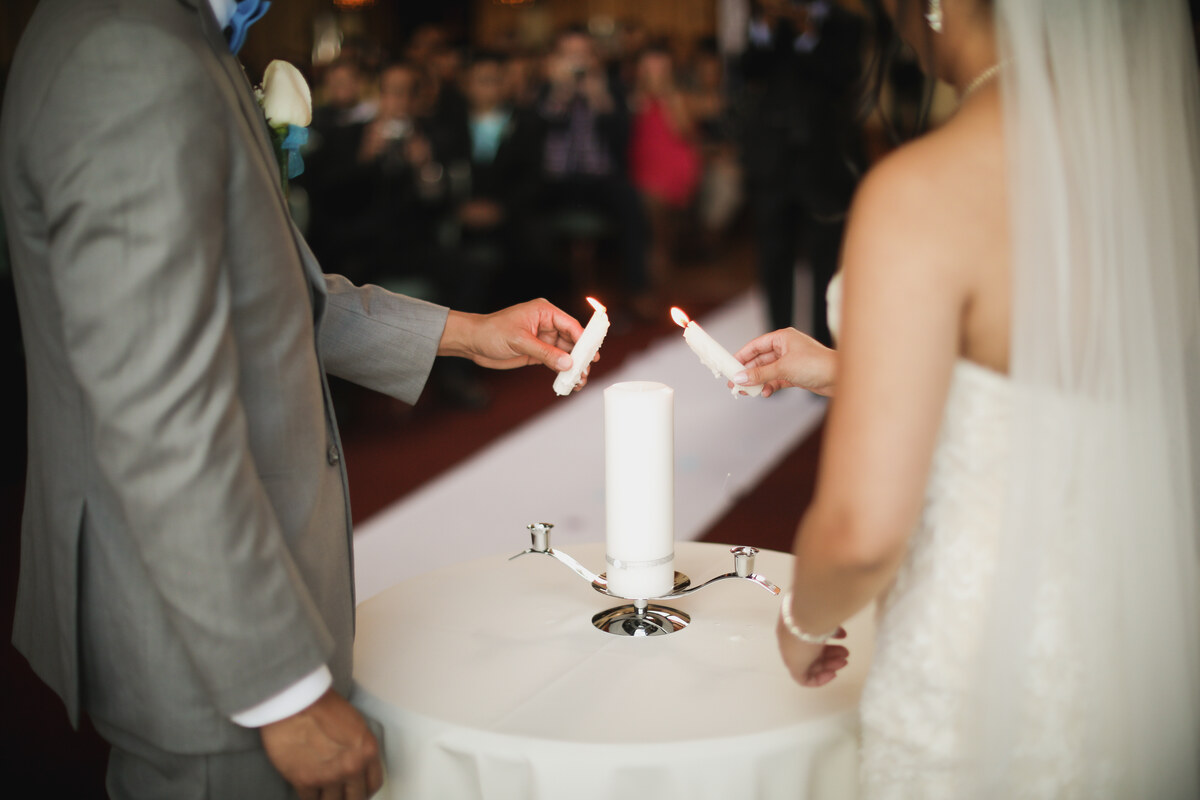
In another version, the bride and groom light their own families’ candles themselves before lighting a center candle together.
Either way, the meaning is the same: two people who come from separate families are becoming one in marriage. It is a lovely way to give both families a visible place in the ceremony, without a single word being spoken.
Blow out the small candles or keep them lit
One small detail carries a lot of meaning, and it is worth deciding on ahead of time. When the candle lighting is meant to symbolize the joining of the bride and groom, the two taper candles can be handled in two different ways.
Some couples blow them out once the center candle is lit, to show that their two lives are now permanently merged. Others leave them burning beside the central candle, a sign that each partner keeps their own individuality within the marriage.
Neither choice is more correct than the other. It is simply a question of which message feels most like the two of you.
Why your church may say no, and what to do instead
Because the unity candle is a recent addition and not part of the apostolic tradition, some churches do not allow it during the ceremony. That is why couples and their wedding planner should always check with the pastor before adding it to the order of service.
The Catholic Church is a good example. The unity candle is not part of the Catholic wedding liturgy, and the updated Rite of Marriage makes no provision for it, so many parishes do not allow it. The United States Conference of Catholic Bishops has not explicitly prohibited it, but it does not encourage it either.
Most dioceses do not ban the custom, but many suggest moving it to the reception, since the marriage rite already holds abundant symbols of unity. Where it is permitted, the guidance is precise: the couple lights their individual candles from the paschal candle, those candles are not extinguished, and the unity candle is not placed on the altar.
In Anglican weddings, the candle ceremony is not part of the service either, although the pastor may allow it at their discretion.
A few gentle tips for your own candle moment
If a unity candle speaks to you, bring it up with your officiant early in the planning. Knowing the rules of your church ahead of time saves any last-minute surprise.
If the ceremony itself is not an option, the reception can be a beautiful home for it, exactly as many dioceses suggest. Then decide together whether your two small flames will go out or keep shining beside the big one.
However you light it, the unity candle may be young, but the promise it stands for is the one at the heart of every wedding.