In India, there is a playful wedding joke every bride seems to know: the darker your mehndi turns, the more your partner loves you. It is only a cultural joke, of course, but it sits on top of a bridal tradition thousands of years old, and on a little bit of real plant chemistry too.
Mehndi is the art of decorating the skin with a paste made from henna, the plant known as Lawsonia inermis. For brides across South Asia, North Africa and the Middle East, it is one of the most beautiful parts of getting ready to marry.
Why the color keeps deepening after the paste comes off
The paste is made from the powdered dry leaves of the henna plant and applied with a plastic cone, a brush or a simple stick. In India, the cone looks a lot like the ones used to pipe icing onto cakes, while in Morocco a syringe is common.
About fifteen to twenty minutes after application, the paste dries and starts to crack. It is often wrapped to hold in body heat and dabbed with lemon juice and sugar so it stays on longer. The longer it stays, the darker and longer lasting the stain.
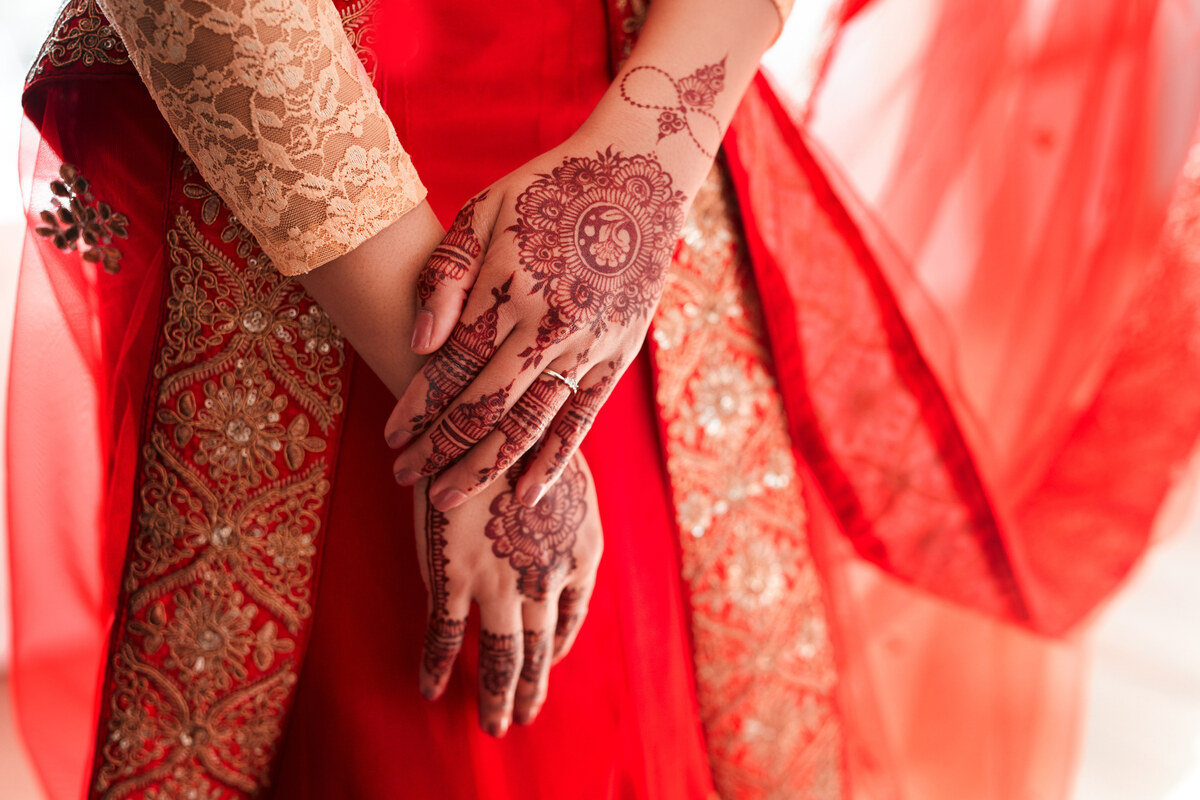
Here is the lovely part: when the paste is first removed, the design is only pale to dark orange. It keeps darkening through oxidation for 24 to 72 hours, ending in a rich reddish brown that can last one to three weeks. Thicker skin stains darker and longer. So a bride watching her hands deepen in color over the days before her wedding is seeing exactly what henna is meant to do.
A bridal custom much older than the mehndi night
Assyrians of the 8th century BC are among the earliest known peoples to use it in a marital context: one Assyrian text mentions henna dye applied to the palms and fingernails of women who were getting married.
The earliest text linking henna to wedding celebrations is the Ugaritic legend of Baal and Anath, in which women mark themselves with henna before meeting their husbands. This early connection between young brides and henna seems to be the origin of the Night of the Henna, celebrated by Jews, Muslims, Sikhs and Hindus, among others, wherever the plant grew naturally.
Henna was believed to carry barakah, or blessings, and was applied for luck, joy and beauty. That is why brides traditionally wore the most henna and the most intricate patterns of anyone at the celebration. In India, it became especially popular under the Mughal Empire, from the early 1500s to the mid 1800s.
Henna nights from Algeria to Malaysia
The name henna night comes from the fact that, in most cultures, it takes place on the last night before the wedding. It has often been compared to a bachelorette party, with music, dancing, food and gifts for the bride. The groom and guests frequently receive designs too.
The details are what make it so charming:
- Algeria: the couple seal their vows in front of their guests with a circle of henna on the palm, usually applied by their mothers or grandmothers.
- Saudi Arabia: the design is often chosen by a female relative who is already in a happy marriage, as a wish for good luck.
- Pakistan: the Rasm-e-Heena is one of the most important pre-wedding ceremonies, usually held the day before the wedding.
- Yemenite Jewish tradition: guests receive a blot of henna on the palm, a sign of a long-lasting marriage since henna stays for many days.
Love and henna are linked elsewhere, too. Among Bulgarian Romani, tradition holds that the longer the bride’s henna lasts, the longer her husband will love her.
Designs carry their own little secrets as well. South Asian brides often wear small, intricate patterns with flowers, paisleys and peacocks, and the names or initials of the bride and groom are sometimes hidden inside the design.
Planning your own mehndi with care
If you would love a henna night of your own, the 24 to 72 hour darkening window is worth keeping in mind when you pick the date, so your design is at its deepest color on the day itself.
Just as important, choose natural henna, which gives a red-brown stain. Products sold as black henna may contain PPD, a dye that can cause severe allergic reactions and permanent scarring, and it is illegal for use on skin in Western countries. A simple warning sign: if a paste stains the skin on the torso black in less than half an hour, it contains PPD.
Choose real henna and a joyful evening with the people you love. Whatever color your hands turn, the joke will still make everyone smile.