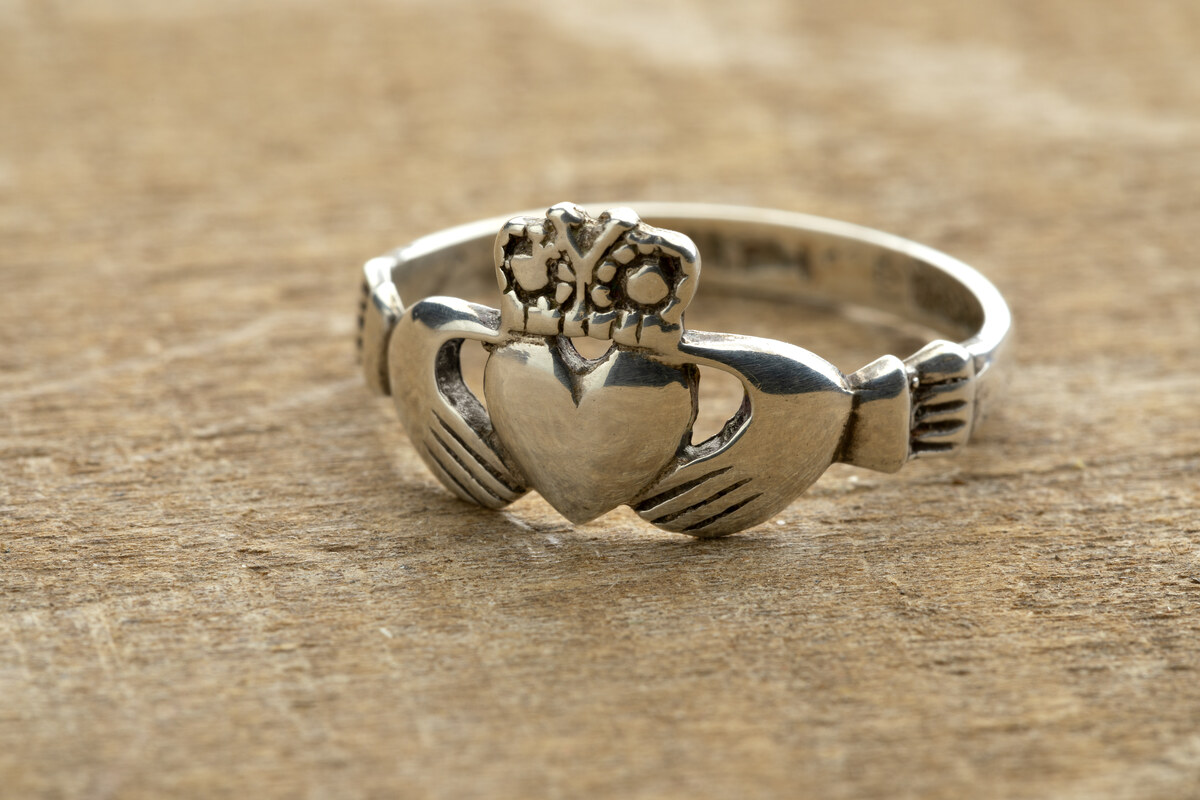
A Claddagh ring does more than look pretty. Depending on which hand it sits on and which way its little heart points, it is said to tell the world whether the person wearing it is single, in a relationship, engaged or married.
Behind that charming code is a ring with deep Irish roots, a famous legend and a surprisingly long list of admirers.
Three symbols in one small ring
The design is instantly recognizable: two hands clasping a heart, usually topped with a crown. Each element carries its own meaning. The heart stands for love, the hands for friendship and the crown for loyalty.
The Claddagh belongs to a wider family of European rings known as fede rings, from the Italian phrase mani in fede, meaning hands joined in faith. That gesture goes back to Ancient Rome, where clasping hands meant pledging vows, and fede rings were used as engagement and wedding rings in medieval and Renaissance Europe.
There is also a version without the crown, known as the Fenian Claddagh, although it never became as popular as the crowned design.
A fishing village in Galway and a legendary silversmith
The ring takes its name from Claddagh, a small fishing village in Galway, where it almost certainly originated. Galway has produced these rings continuously since at least 1700, yet the name “Claddagh ring” was not used before the 1830s.
The best known story about its creation involves Richard Joyce, a silversmith from Galway. Legend has it that he was captured by Algerian corsairs around 1675 while sailing to the West Indies, then sold to a Moorish goldsmith who taught him the craft. After fourteen years he was released and came home with a ring he had made in captivity. He gave it to his sweetheart, married her and became a goldsmith with “considerable success”.
It remains a legend, but his initials do appear on one of the earliest surviving Claddagh rings. The oldest surviving examples were forged by Bartholomew Fallon, and three other rings from around the same period bear the mark of goldsmith Thomas Meade.
The four ways to wear it
According to Irish author Colin Murphy, the ring is traditionally worn to show its wearer’s relationship status:
- On the right hand, heart pointing toward the fingertips: single, and perhaps looking for love
- On the right hand, heart pointing toward the wrist: in a relationship, because someone has captured their heart
- On the left ring finger, heart pointing toward the fingertips: engaged
- On the left ring finger, heart pointing toward the wrist: married
Before you worry about getting it wrong, there is a reassuring nuance. This folklore is relatively recent rather than ancient, and it lives almost entirely in oral tradition. Local variations exist across Ireland and the Irish diaspora, and there is “very little native Irish writing about the ring”, so no single rule can claim to be the official one.
From royal hands to Hollywood
Knowledge of the ring spread through Ireland and Britain during the Victorian period, when Galway jewellers began selling it beyond the local area. Members of the British royal family, including Queen Victoria, were seen wearing it after traveling to Ireland in 1849.
John F. Kennedy and his wife received theirs on a trip to Galway in 1963, while Ronald Reagan and Bill Clinton were both given the ring as a gift from Ireland. Maureen O’Hara and John Wayne received their rings during the making of The Quiet Man, and Walt Disney was seen wearing one after visiting Ireland with his wife.
A ring worth passing down
Claddagh rings are sometimes exchanged between friends, but they are most commonly used as engagement and wedding rings, especially among people of Irish heritage. In Ireland, the United States, Canada and elsewhere in the diaspora, the ring is sometimes handed down from mother to eldest daughter, or from grandmother to granddaughter. Some mothers also give one to a daughter when she comes of age.
If you have Irish roots, or simply love what the ring stands for, a family Claddagh could make a lovely “something old” on your wedding day. You might even borrow one of the mottos associated with it for an engraving: “Let love and friendship reign”.