When we picture a wedding veil, we almost always picture it on the bride. Yet across the Indian subcontinent, the groom often arrives wearing one of his own: a sehra of flowers or beads tied to his turban.
It is one of the loveliest reminders that wedding style is never only about the bride. Behind the sehra, and the long embroidered coat that usually comes with it, there is a surprisingly rich history.
A garland made for the head
The word sehra comes from the Sanskrit Śīrṣahāra, which simply means a garland for decorating the head. The word appears in the Braj poetry of Suradāsa, the Hindu Bhakti saint.
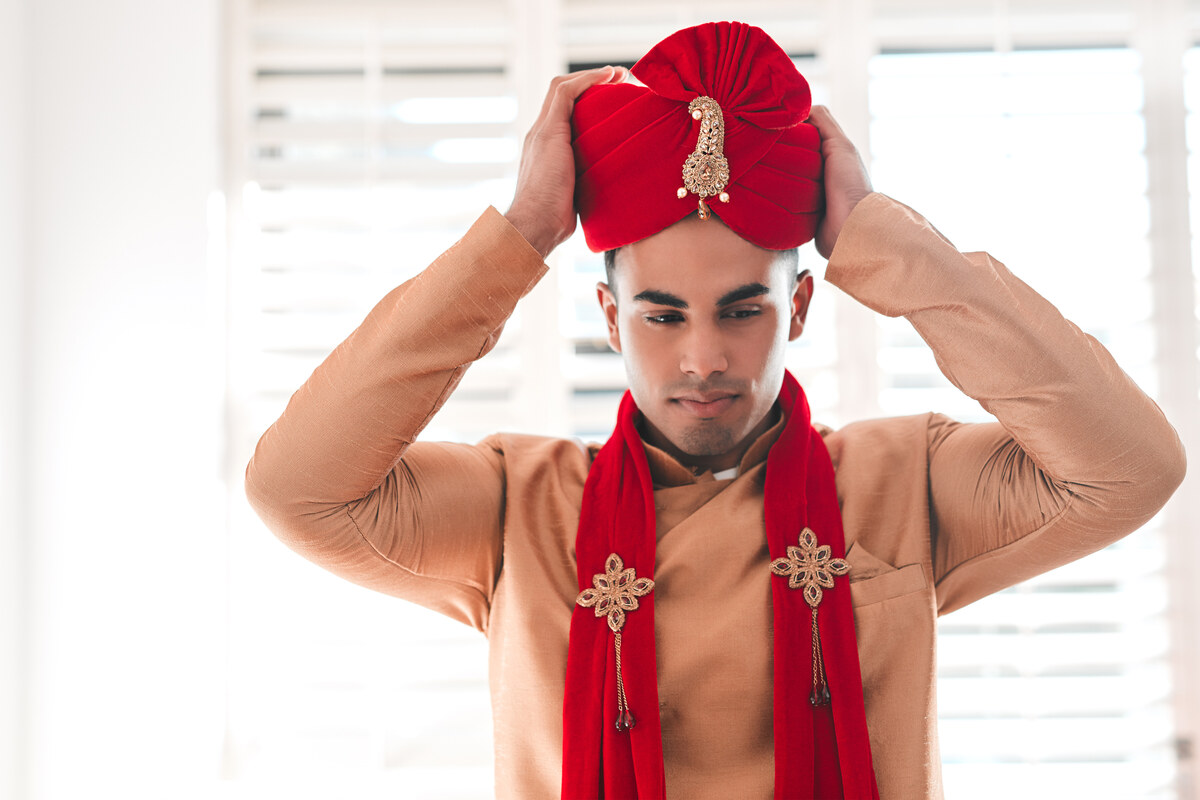
Today it is a forehead garland worn during weddings in the Indian subcontinent, by the groom or by the bride. It can be made of fresh flowers or of beads, and it is tied to the groom’s turban, the pagdi.
Almost every language of the region has its own name for it. It is a sehro in Gujarati, a sevrau in Rajasthani, a mundavalya in Marathi, a morrah in Sindhi and a basikam in Telugu.
The moment it is tied on even has its own name: sehra bandi, performed right before the groom leaves for the bride’s house. The custom also travelled far from South Asia, since the sehra is worn by Caribbean Hindu grooms as well.
The coat underneath started in Lucknow in the 1820s
Under the sehra, many grooms wear a sherwani, a fitted, long-sleeved coat that falls below the knees and buttons down the front. It can be collarless, have a shirt-style collar or a stand-up collar.
It feels timeless, but the sherwani is younger than many people assume. It first appeared in Lucknow in the 1820s, as the European-style court dress of regional Mughal nobles in northern India. According to Emma Tarlo, it grew out of a Persian cape called the balaba, which took on a more Indian form, the angarkha, before gaining buttons down the front in line with European fashion.
Royalty and aristocrats across the subcontinent adopted it first, then the general population. Its name may come from Shirvan, a region of present-day Azerbaijan, whose folk dress looks strikingly similar.
Once a mark of the nobility, the sherwani is now famous above all as a wedding outfit, prized for the regal feel it gives the person wearing it.
Sherwani, achkan or Jodhpuri suit
If you are shopping for a South Asian wedding, you will likely meet three close cousins.
- The sherwani always opens straight down the front and is typically more flared at the hips. It has historically been favored by Muslims, and today it is mostly worn in Pakistan, India and Bangladesh, usually with detailed embroidery.
- The achkan is another knee-length jacket, also said to have been invented in Lucknow. It traditionally opens at the side, tied with strings, and was traditionally worn with a sash wrapped around the waist. It is generally associated with Hindus, is commonly worn by grooms today, and later evolved into the Nehru jacket.
- The Jodhpuri suit, or bandhgala, meaning closed neck, comes from the princely state of Jodhpur in Rajasthan. By the 19th century the royal family had refined it into a waist-length jacket suited to horse riding and polo, worn with the tight breeches that became known as jodhpurs. It was even nicknamed the prince suit.
What goes on the legs changes with the country, too. In India the sherwani is mainly paired with churidars or pyjamas, while in Pakistan and Bangladesh it is usually worn with a shalwar. In Pakistan, the sherwani is the national dress for men. After independence, Muhammad Ali Jinnah wore it frequently, and presidents, prime ministers and officials followed his lead with a formal black sherwani on state occasions.
Bringing it into your own wedding
If you are planning a South Asian or fusion wedding, these pieces offer lovely room for personal touches. The bride’s look has its own traditions: wedding saris are usually red, a color associated with married women, often in silk with golden brocade, while Gujarati brides wear red and white panetar saris.
The sherwani is not reserved for grooms, either. The Pakistani filmmaker Sharmeen Obaid-Chinoy wore one when she won the Academy Award for Best Documentary Short Film, in both 2012 and 2015.
Whether you choose fresh flowers or beads for the sehra, a front-buttoned sherwani or a high-collared bandhgala, each piece carries centuries of court fashion, poetry and family ritual. It is a beautiful way to let both partners arrive looking like royalty.