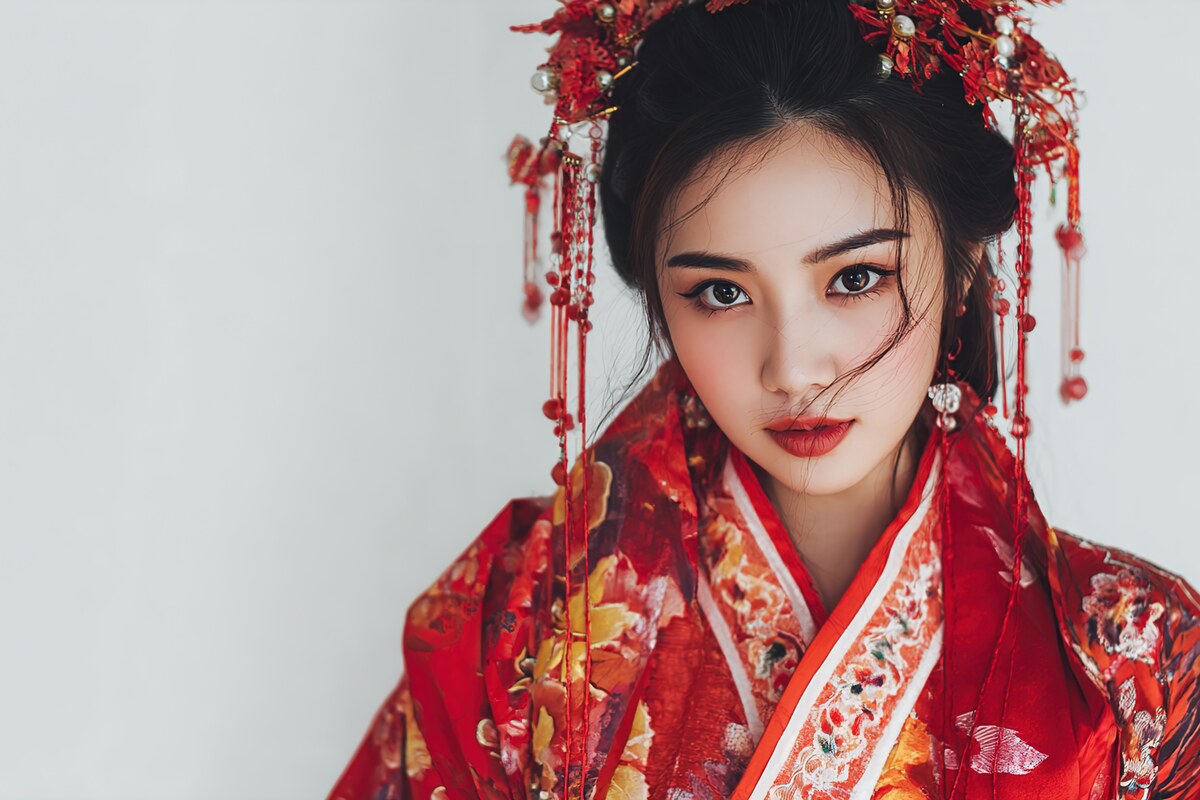
Picture a traditional Chinese bride today and you probably see a cloud of red and gold embroidery. Yet the jacket of the classic Cantonese wedding dress, the qungua, was originally black. The all-red version only appeared in the 1960s, and the story behind that change is a lovely one.
A wedding dress that began with an emperor’s gift
The qungua (also called longfenggua, the “dragon and phoenix” set) is a two-piece outfit: a jacket called the gua, which buttons down the front, and a long, usually straight skirt called the qun. It follows a very old Chinese way of dressing, with one garment for the upper body and another for the lower body.
It first appeared in the 18th century, during the Qing dynasty. According to its origin story, a Guangdong politician named Liang Zhu was rewarded by the emperor with a silk wedding dress embroidered with dragons and phoenixes when his daughter married. The style caught on across the region, and the qungua became the traditional wedding attire of Cantonese brides.
It was also deeply personal. In the 18th century, Chinese mothers would start sewing the qungua as soon as a daughter was born, and the finished dress later became part of her dowry. A bride walked into her marriage wearing years of her mother’s patient handiwork.
Why the jacket used to be black
While Western wedding dresses tend to be white, traditional Chinese wedding clothing favors red and gold. Originally, though, only the skirt of the qungua was red. The gua was black.
The completely red jacket only arrived in the 1960s. Since then, the older pairing of a black jacket with a red skirt has found a new role: it is now worn by the bride’s mother rather than by the bride herself. The look that once dressed brides now dresses their mothers, so two generations share the same story on one wedding day.
Before the qungua, a crown of phoenixes
Before the qungua, brides of the Ming and Qing dynasties wore a set called fengguan xiapei. It combined a red “python jacket” embroidered with dragons, a red or green skirt decorated with dragons and phoenixes, a xiapei, and a fengguan.
The xiapei was a long embroidered scarf, later shaped like a fringed sleeveless vest. Its name means “rosy cloud scarf”, earned during the Sui and Tang dynasties because it was its beauty was compared to rosy clouds. Under the Qing, ordinary women could wear one only on rare occasions, such as their wedding.
The fengguan, or phoenix crown, was a ceremonial headdress for noblewomen, decorated with phoenixes made of inlaid kingfisher feathers, gold dragons, pearls and gems. The most lavish were truly imperial: the crown of Ming Empress Xiaoduanxian has 6 dragons, 3 phoenixes, 5,449 pearls, 71 rubies and 57 sapphires, and such crowns could weigh 2 to 3 kilograms. Brides from ordinary families wore colorful hats on their wedding day that were also called fengguan, a custom believed to date back to the Southern Song, when an emperor rewarded a girl who had saved his life. The crown was a symbol of good fortune.
Choosing a qungua today
The qungua is still a popular wedding dress in China, including Hong Kong and Macau, and it is traditionally made by hand. Today there are five types, named after how much of the dress is covered in embroidery: xiaowufu (30%), zhongwufu (50%), dawufu (70%), guahou (90%) and guahuang (100%).
Beyond dragons and phoenixes, the embroidery can carry other lucky symbols: pomegranates for fertility, peonies, lotus flowers, bats, goldfish, butterflies and birds. Brides who prefer another silhouette can choose the xiuhefu, with a jacket that closes on the right side and an A-line skirt embroidered with flowers and birds, or a one-piece cheongsam.
And there is no single right answer. In modern Chinese weddings, brides generally pick red to follow tradition or white for a more Western look. Whichever you choose, the qungua is a gentle reminder that a wedding outfit can carry a whole family’s history, sometimes stitched one thread at a time from the day a daughter is born.