At many Jewish weddings, there comes a moment when the bride and groom are lifted high above the dance floor, each on a chair, holding a handkerchief between them while the circle of guests spins below. It is one of the most joyful images of a wedding, and it belongs to a much bigger family of dances.
From the Balkans to the Levant, guests have celebrated new couples by joining hands and moving together in a ring. Here is a short tour of the circle dances still found at weddings today.
The hora, a dance whose name may simply mean circle
The word hora comes from the Greek khorós, meaning “dance”, and its original meaning may have been “circle”. The same root gave its name to the Bulgarian horo, the Macedonian oro and the Hebrew horah.
In Romania and Moldova, the hora is danced with everyone holding hands while the circle turns, usually counterclockwise. Each dancer follows a simple pattern of three steps forward and one step back. It is popular at weddings and festivals, and remains an essential part of celebrations in rural areas.
In Bulgaria, the horo does not even need to be a closed circle, as a curving line of dancers works just as well. There are probably over one hundred types of horo in Bulgarian folklore. Some can be learned in five to ten minutes.
How the horah came to Jewish weddings
The Jewish horah grew out of these Eastern European circle dances. In 1924, the dancer and choreographer Baruch Agadati created a dance based on the Romanian hora, known as the Hora Agadati, which toured the pioneer settlements of the Jezreel Valley. Today the dance is often performed to the music of “Hava Nagila”.
The horah actually reached North America in the early 20th century, carried directly from Eastern Europe by Jewish immigrants. Guests form a circle, holding hands or linking arms behind their backs or on their shoulders, and step together to the left. With a big crowd, the dance can grow into several circles, one inside the other, or a large spiral.
Then comes the chair lift. The custom of raising the bride and groom, each on their own chair and linked by a handkerchief, was later copied at b’nai mitzvah, where the guest of honor is lifted in the same way.
Kolo, dabke and khigga across the region
In Serbia, Bosnia and other South Slavic regions, the kolo takes its name from the circle itself. Dancers, often several dozen of them, place their hands around each other’s waists, and there is almost no movement above the waist. It is performed at weddings and at cultural and religious celebrations.
In Lebanon, Jordan, Palestine and Syria, wedding guests dance the dabke, which combines a circle with a line. Its name is thought to come from a word meaning “stamping of the feet”. A skilled leader heads the line, and once the dancers are moving in sync, the other guests at the wedding join in, one after another. One theory even says the stamping began as a way for neighbors to pack down mud roofs together.
At Assyrian weddings, the khigga is the first beat played to welcome the bride and groom into the reception hall. The person at the head of the line waves a handkerchief decorated with beads and little bells, so it jingles with every shake.
Guests were stamping in a circle more than 400 years ago
None of this is new. In 1577, the traveler Salomon Schweigger described a Greek wedding in Constantinople, where guests “joined arms one upon the other, made a circle, went round the circle, with their feet stepping hard and stamping; one sang first, with the others all following after.”
Eleven years later, the German pharmacist Reinhold Lubenau watched another Greek wedding in the same city. He saw groups of ten or more people who “took each other by the hand, made a round circle, and now stepped backward, now forward”, singing as they went. Change the music, and it could be a description of a reception this weekend.
Bringing a circle dance to your own reception
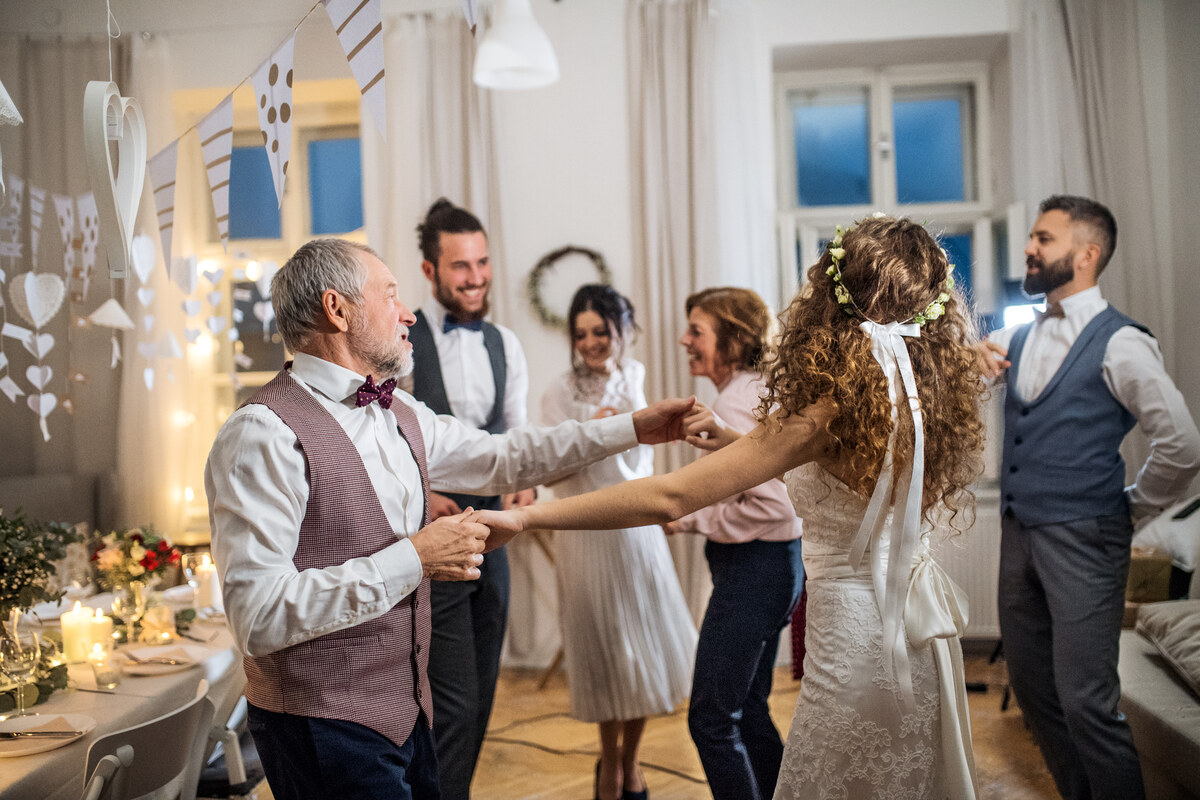
The beauty of a circle dance is that nobody needs to be a good dancer. The steps are short and repetitive, and the person next to you is holding your hand. It is one of the easiest ways to get grandparents, cousins and shy friends onto the floor at the same time.
If your family has its own tradition, whether the horah, the kolo or the dabke, ask an older relative to lead the first round so younger guests can follow. And if the chairs come out, hold on to that handkerchief. It is one of the happiest views of the whole day.