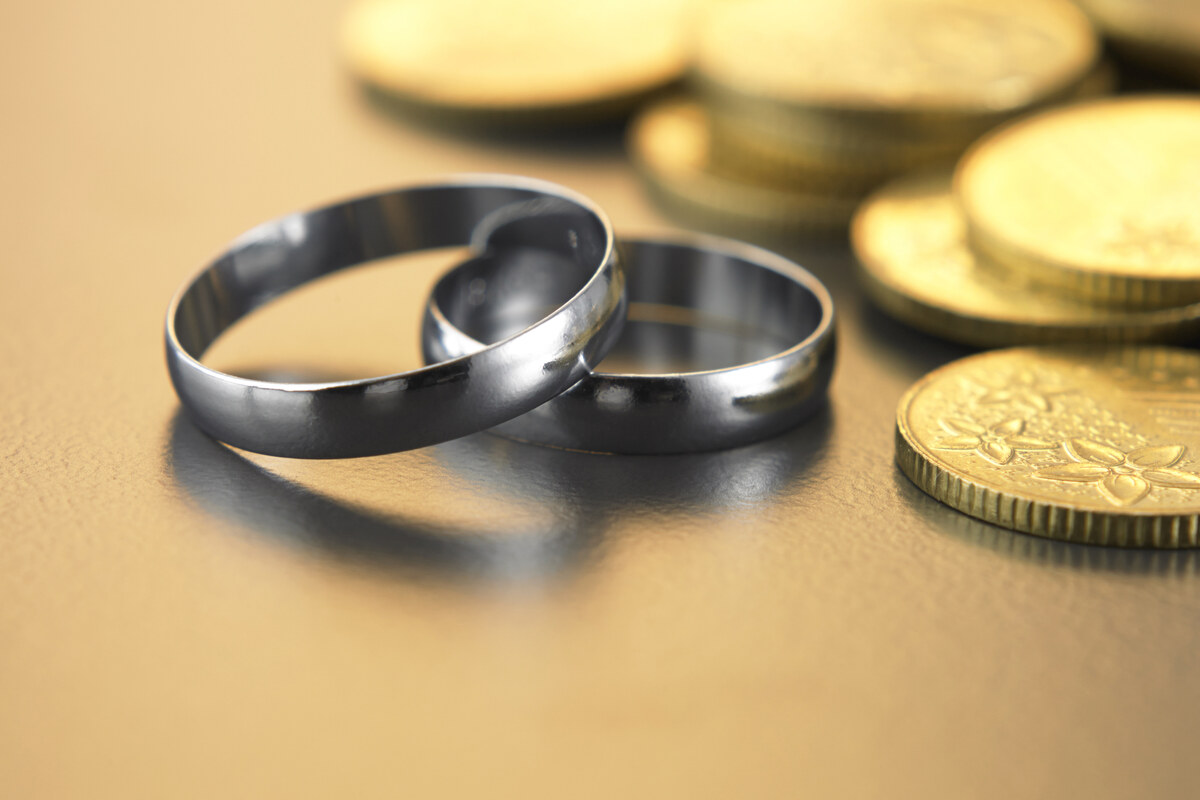
At many weddings in Spain, Latin America and the Philippines, there is a quiet moment when the groom hands his bride a set of blessed coins. There are thirteen of them, and each one carries a little piece of history.
The custom is called las arras, or las arras matrimoniales, sometimes translated as wedding tokens, arrhae or unity coins. Here is the story behind it, and how to include it in your own ceremony.
A promise you can hold in your hands
In Spain and Latin America, the arras are traditionally thirteen gold coins presented in an ornate box or chest. In the Philippines, they are usually kept in a decorated basket or pouch, and they can be gold or silver. A priest blesses the coins first, and then the groom gives them to his bride.
The gesture is gentle but meaningful. The exchange represents the groom’s promise to provide for his family and the bride’s trust in his ability to do so. Filipino couples often describe the arrhae as a pledge that the groom is devoted to the well-being of his wife and their future children.
There is even a special job in the wedding party for it. At Filipino and Hispanic weddings, a coin bearer often walks alongside the ring bearer, carrying the arras in their case on a cushion.
Why thirteen coins, and where the word comes from
The word arras is Spanish and means “earnest money”, the same idea as a deposit that seals a deal. It comes from arrhae, the plural of arrha, and it has also been linked to the notions of bride price and bride wealth. To this day, in legal terms, an arras is a payment given as proof of commitment before a contract is completed.
The number thirteen has a lovely explanation. The coins traditionally stand for the twelve months of the year, with the thirteenth set aside for the poor. Today many couples see them as a symbol of Jesus and the twelve apostles.
Historians do not fully agree on where the custom began. One reference work traces it to gold rings or coins in Visigothic law, while another points to Frankish marriage ceremonies. The historians Lyndon Reynolds and John Witte note that the Franks gave thirteen pennies at their weddings while the Spanish gave coins or another marriage gift, and suggest the two practices merged in the 11th century. Ancient Rome had its own version too: breaking a piece of gold or silver into two equal halves as a promise to marry.
A silk cord shaped like the number 8
The coins often have a partner ritual: the wedding cord, known as el lazo or the wedding lasso. It is common in Mexico, the Philippines and Spain, and it is usually a loop of white satin or silk made to look like rosary beads.
After the vows, while the couple kneels, two guests chosen for the honor drape the cord around their shoulders in a figure eight, starting with the groom. In the Philippines, the 8 is considered a lucky number and is also read as an infinity sign, a wish for “everlasting fidelity.” Some cords are made of flowers, linked coins or a long double rosary instead of silk. The cord stays in place until the end of the service, and the bride usually keeps it afterwards as a keepsake.
Binding a couple together is far older than the lasso itself. In the pre-colonial Philippines, a wedding could last three days, and a couple was declared married once their necks and hands were bound by a cord, or sometimes when their long hair was entwined.
How to make the tradition your own
The arras is not only a Hispanic idea. In his 1833 novel Eugénie Grandet, Balzac described the “marriage dozen” of central France, where families gave a bride a purse of twelve coins, or more, according to their means. “The poorest shepherd-girl never marries without her dozen, be it only a dozen coppers,” he wrote.
If you would like to include these rituals, you are in good company. The Catholic bishops of the United States approved the arras and the lazo as optional rites in Spanish in 2010, and in English in 2016. A few practical tips:
- Ask your officiant early whether the arras and the lazo can be included, and when they fit in the service.
- Choose a coin bearer and a pair of cord sponsors, a lovely way to honor a godparent or a favorite couple.
- Pick a box, pouch or basket you will be happy to display at home.
Whether your coins are gold, silver or simply sentimental, the message stays the same: a promise to look after each other, held right there in your hands.