For generations, an old Irish custom gave women a special day to do the proposing: 29 February. And if the man said no, tradition expected him to make it up to her, often with a pair of gloves or a silk gown.
A legend of two saints and a bargain
The custom is known in Ireland as Bachelor’s Day, or sometimes Ladies’ Privilege. Its favorite origin story features two of Ireland’s most famous saints.
According to the legend, Saint Bridget went to Saint Patrick in the 5th century with a complaint: women had to wait far too long to marry, because men were so slow to propose. Patrick offered women one day every seven years to ask instead. Bridget talked him into one day every four years, which is how the leap day became theirs.
It is best enjoyed as a legend. The link to Patrick and Bridget is considered doubtful, and the tradition is not recorded before the 19th century. By the 1800s, though, it was well established, and the Irish Folklore Commission collected several stories about it between 1937 and 1939.
There was also a very practical reason for proposals to cluster in late February. Weddings were not allowed during Lent, and being single by Easter was not a comfortable place to be. Unmarried people could find their names in “Skellig Lists”, teasing ballads named after the Skellig Islands, where Lent was believed to start a little later than in the rest of Ireland. It was the last chance for a quick wedding.
What saying no would cost him
The legend has a charming ending. Bridget is said to have proposed to Patrick the moment he agreed. He turned her down gently, with a kiss on the cheek and a silk gown, and that gesture became the model for every refusal after it.
In Irish tradition, a man who declined a leap day proposal was expected to offer the woman something in return. It might be gloves or a silk gown, and by the mid 20th century, even a fur coat. In some accounts he also had to perform a juggling trick on Easter Day.
The idea traveled well:
- In parts of Europe, a man who refused had to buy the woman twelve pairs of gloves, supposedly so she could hide the fact that she was not wearing a ring.
- In Finland, he was expected to buy her the fabric for a skirt.
The Scottish law that never existed
You may have read about a lovely detail: a Scottish law from 1288 that allowed women to propose in leap years, required them to wear a red petticoat while doing so, and fined any man who said no.
It is a wonderful story, but it has no basis in historical fact. The law is usually credited to the young, unmarried Queen Margaret, who was in fact five years old at the time and living in Norway. What did exist was a superstition: a man who declined a proposal from a woman in a red petticoat could expect bad luck.
England had its own explanation. Under traditional English law, 29 February was not a legal day, so the usual expectation that women would not propose simply did not apply. A play from the turn of the 17th century, The Maydes Metamorphosis, already joked that “this is leape year/women wear breeches”.
Who proposes today, and why it is rarely a surprise
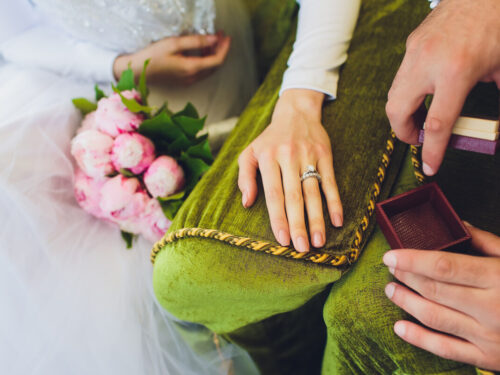
The picture we all know, a man on one knee holding a small velvet box, remains the classic image. Most proposals in the United States and Australia are made by men, and a man traditionally asks the woman’s father for permission first, a step now often understood as a formality.
Yet when people in both countries are asked whether a woman proposing is acceptable, most say yes. Jewelry companies have even started advertising engagement rings for women proposing to men. And there is a royal precedent: Queen Victoria proposed to Prince Albert, because British royal tradition holds that no one can propose to a reigning monarch.
Here is the most reassuring detail of all. Surveys have found that most proposals are not actually a surprise. Most engagements begin with a conversation in which a couple simply agrees, together, that they want to marry. Same-gender couples often keep some parts of the ritual and change others, and sometimes each partner proposes to the other.
So if you are dreaming of asking rather than being asked, you do not need to wait for 29 February. The leap day tradition is a sweet piece of folklore, but the best moment to propose is simply the one that feels right for the two of you.