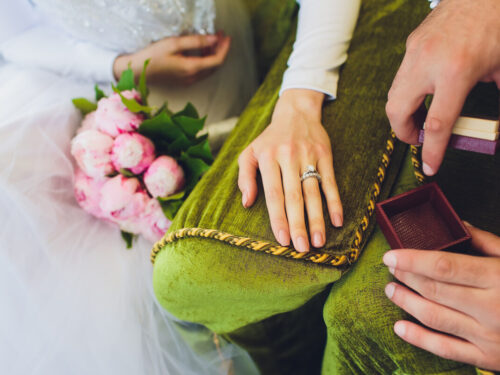
On 10 August 2003, Ekaterina Dmitriev said her vows in Texas while her groom, cosmonaut Yuri Malenchenko, was orbiting the Earth aboard the International Space Station. It sounds like a movie plot, but it was a perfectly legal proxy wedding. And this way of marrying, without one or even both partners in the room, is far older and more common than most couples imagine.
What a proxy wedding actually is
A proxy wedding is a ceremony in which one or both of the people getting married are not physically present. Usually, another person stands in for them. When both partners are absent, it is called a double proxy wedding.
Couples tend to choose it for one of two reasons. Either one or both of them cannot attend, because of military service, travel restrictions or imprisonment, or they live somewhere they cannot legally marry. In most places, though, the law still expects both partners to be there in person, and a proxy wedding is not recognized as legally binding.
Kings and queens married by proxy for centuries
Starting in the Middle Ages, European monarchs and nobles regularly married this way, and the practice had largely died out by the end of the 19th century. One of the first known proxy marriages in Western history joined Clovis I, King of the Franks, and Clotilde in 496. Marie Antoinette married the future Louis XVI by proxy in 1770, and Napoleon married Archduchess Marie Louise of Austria the same way in 1810.
Some of these ceremonies came with wonderfully strange symbolism. When Maximilian of Habsburg married Anne of Brittany by proxy in 1490, his representative, Wolfgang von Polheim, went to bed with the bride on the wedding night wearing a full suit of armour, covering all but his right leg and hand. A sword was placed between them. The proxy marriage of Marie de’ Medici in 1600 was even immortalized in a famous painting by Peter Paul Rubens.
Wartime weddings by telephone
During both World Wars, many soldiers at the front married their sweethearts back home by proxy, often taking part in the ceremony by telephone. France allowed proxy marriage by law from 4 April 1915, Italy from 24 June 1915 and Belgium from 30 May 1916. During the Second World War, proxy weddings were common in the United States and the United Kingdom, and one lawyer in Kansas City, Kansas, helped arrange 39 of them.
Distance brought couples together in other ways too. Between 1907 and 1923, 14,276 Japanese and 951 Korean “picture brides” arrived in Hawaii after proxy weddings at home, often marrying again at the dock or in hotels as soon as they landed. Later, between 1945 and 1976, 12,000 women in Italy married Italian Australian men by proxy before travelling to Australia to meet their new husbands.
Where proxy weddings are legal today
In the United States, proxy marriages are provided for in Texas, Colorado, Kansas and Montana. Montana is the only state that allows a double proxy wedding, and only if at least one partner is on active military duty or is a Montana resident. California offers proxy marriage only to deployed military personnel, and Iowa does not recognize proxy marriages at all.
Elsewhere, the rules vary widely. France does not allow proxy marriages, while Germany does not perform them but may recognize one contracted in a country where it is legal. In India, couples can marry by video link, even from separate countries, as long as witnesses are present, and in Pakistan proxy marriages, including by telephone, are legal if witnesses attend and the marriage is properly registered. Catholic canon law permits marriage by proxy with prior authorization from local church authorities, while Hindu weddings generally do not allow it, since the bride and groom must walk the seven steps of the Saptapadi together.
A few gentle tips if you are apart
If you and your partner are separated by deployment or distance, a proxy wedding can be set up by a lawyer in a place that permits it, and video conferencing now lets you share the ceremony together in real time. Before you plan anything, check that your marriage will be recognized where you live. As Citizens Advice Scotland warns, “it may be extremely difficult to prove that a marriage by proxy is a valid marriage, both legally and for claiming benefits.”
And if what you really want is an intimate ceremony with no officiant at all, a few places allow that too. Colorado lets couples hold their own ceremony and sign their own marriage license, and the District of Columbia allows couples to officiate their own wedding. Whichever path you choose, the heart of the day stays the same: two people promising to share a life, even when, for now, they are far apart.