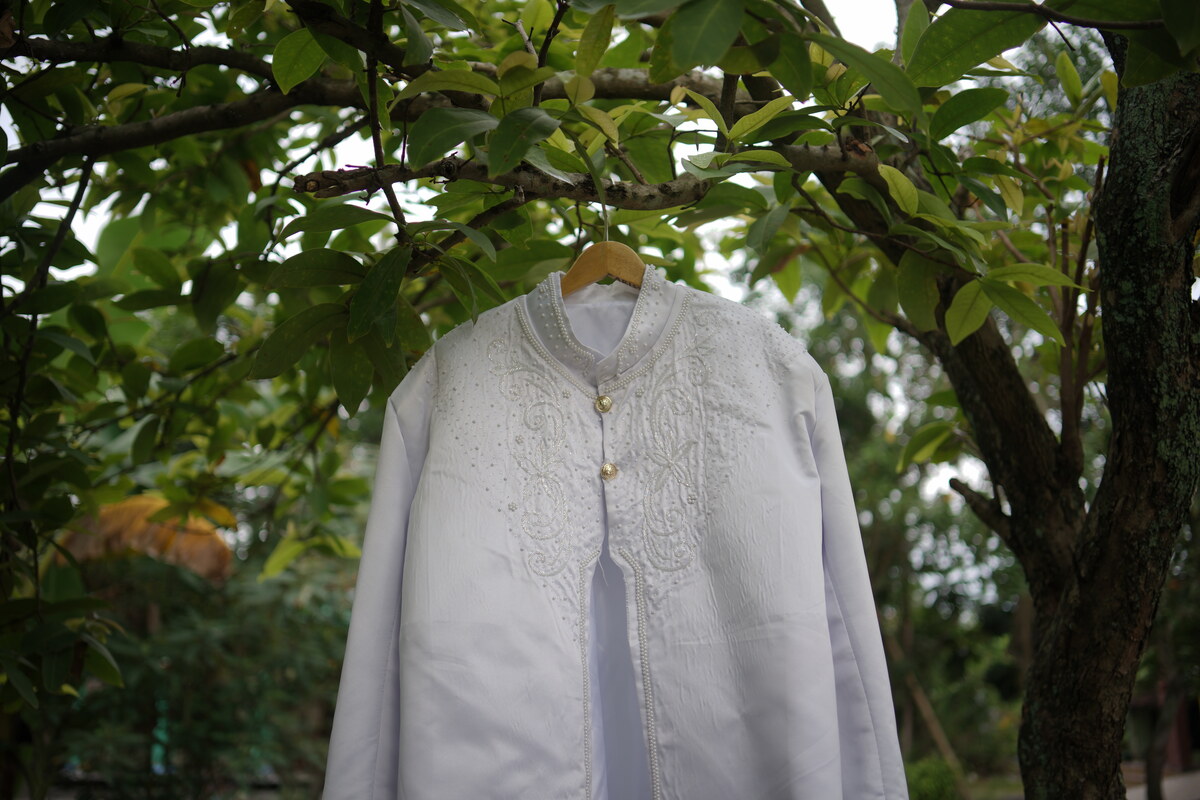
At a Filipino wedding today, the groom is almost always dressed in a barong tagalog, a sheer embroidered shirt worn loose over an undershirt. It looks like a tradition that has never moved an inch, yet the grooms of the early post-war years mostly married in Western suits, and the barong only took over the aisle by the 1990s.
A shirt with very old roots
The barong grew out of the baro, a simple collarless shirt with close-fitting long sleeves worn by both men and women across most of the pre-colonial Philippines. The word baro simply means outfit or clothing, and the shirt shared its style with the Malay and Javanese baju and the South Asian kurta.
The name barong tagalog does not mean it belonged only to the Tagalog people. It was coined to mark the outfit as native, as opposed to European dress, and it was worn by Christianized lowlanders all over the islands during the Spanish colonial period.
By the 1820s, wealthy local and mestizo men favored the barong mahaba, a long version reaching just above the knee, often striped in bold blue, red or green and worn with a top hat. In the 1840s it gave way to the shorter, more muted shirt we recognize today, usually in black and white, blue and white, or all white.
From political statement to wedding favorite
Under American rule, the barong lost ground to suits, known locally as the Americana, and to tuxedos. The turning point came in 1953, when President Ramón Magsaysay deliberately wore a barong at his inauguration. The press read it as a symbolic break with the colonial past, and the presidents who followed adopted it too.
In 1975, Ferdinand Marcos made the barong and its feminine counterpart, the baro’t saya, the official national attire, and even declared a Barong Tagalog Week from June 5 to 11. Companies such as Philippine Airlines and Allied Bank made it their uniform, and in 1998 it became required for every employee of the judiciary.
Weddings were slower to follow. Even once the barong was accepted as formal wear, most post-war weddings featured a groom in a Western suit next to a bride in a terno. By the 1990s, the picture had flipped: grooms now almost always wear a barong, while brides tend to choose Western-style wedding gowns.
The see-through shirt story that never happened
You may hear a popular explanation for why the barong is sheer and worn untucked: supposedly, Spanish colonizers forced local men to wear it that way so they could not hide a weapon and would never be mistaken for the ruling class.
It is a memorable story, but there are no historical records of any such rule from the 16th to the late 19th century. No regulation required sheer fabric or banned tucking in a shirt. The baro had always been worn untucked, even before colonization, and it was not made of translucent fabric until the 19th century. Differences in fabric came down to fashion and wealth, not law.
Choosing a barong for your own wedding
If a barong is part of your wedding plans, the fabric is where the real choice lies. Piña, hand-woven from pineapple leaf fibers, is the most prized and expensive, with a silky luster, a natural yellowish tint and gently uneven streaks. Piña seda blends it with silk, while jusi, woven from abacá, has an off-white color and a polished feel.
A small word of caution: since the 1960s, most fabrics sold as jusi are actually jusilyn or organza, cheaper machine-woven substitutes. Jusilyn has an even texture without the natural streaks, so it is worth asking exactly what you are buying. Organza is the most affordable option for a formal barong, though some find it a little shiny.
Look for the embroidered panel on the chest, called the pechera, or embroidery scattered over the whole shirt, known as sabog. Skip the shirt-jack style with its wide hem band, which is considered too casual for a wedding. Then wear it the way it has always been worn, loose and untucked, over a simple undershirt, with a little history stitched into every thread.