Picture a classic British wedding party: grey tails, a pastel waistcoat, perhaps a top hat. That elegant cutaway coat did not start life at the altar. It was first cut so that 19th-century gentlemen could ride a horse comfortably in the morning.
A coat made for a morning ride
The name morning dress comes from that very habit. In the 19th century, gentlemen went riding in the morning wearing a single-breasted coat with a cutaway front, curving back into tails. The way the coat is shaped at the waist is equestrian in origin, designed to make riding easier.
At first, this was a fairly relaxed piece of clothing, a more casual form of what was then called half dress. As the century went on, it slowly became acceptable to wear it on more formal occasions in place of the frock coat. By the Edwardian era, it had taken over from the frock coat as the standard daytime choice for formal wear.
You can even read that promotion in the lapels. When the morning coat was considered casual, it was often made with notched lapels. Once it became formal, tailors switched to the pointed, peaked lapels you still see on morning coats today.
Morning really means daylight
Here is a detail that surprises many couples: a morning suit is not only for morning ceremonies. It can be worn to afternoon events that take place before five o’clock. The word morning is best understood as daylight.
The real cut-off comes in the evening. The British etiquette authority Debrett’s states that morning dress should not be specified for events starting after 6 p.m. For a formal evening event, white tie becomes the correct equivalent. The two coats even look different up close: the waist of a morning coat is cut at an angle, while the evening tailcoat is cut straight across.
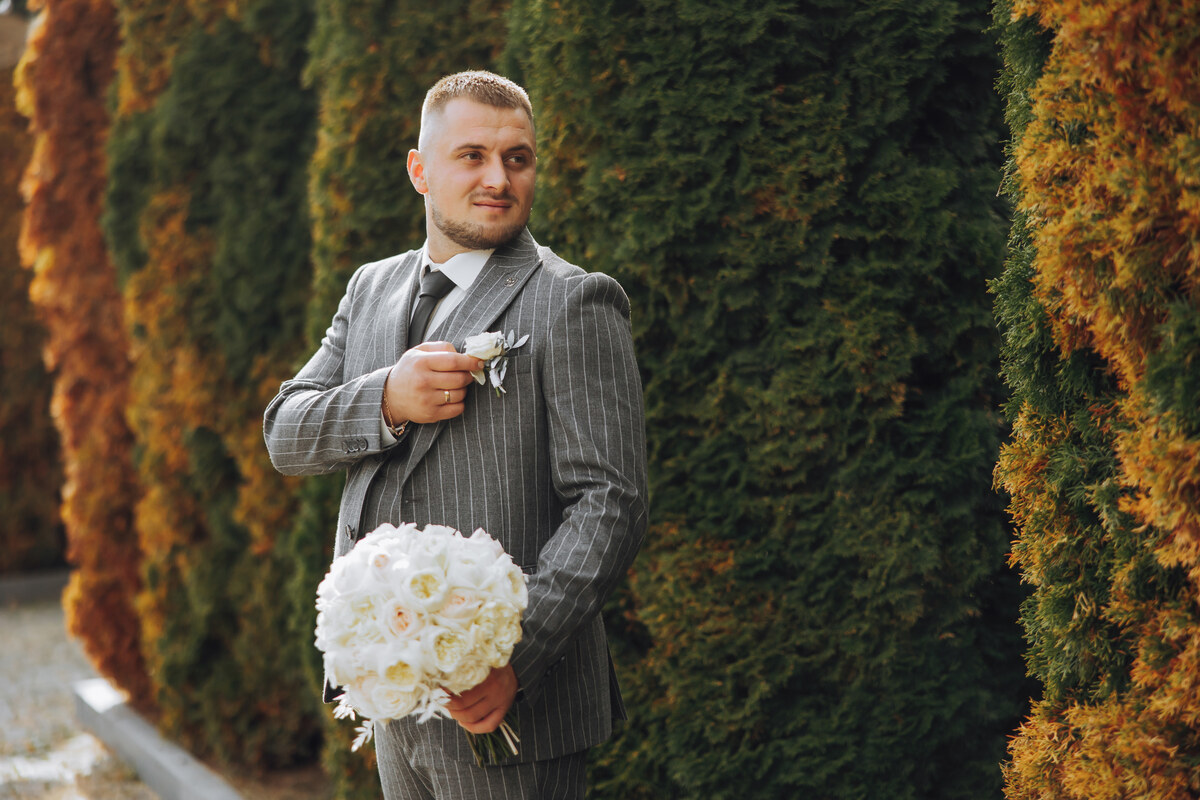
There is also a lighter version for happy occasions. When the coat, waistcoat and trousers are all in the same cloth, often a mid grey, the outfit is called a morning suit or morning grey. It is slightly less formal and considered just right for festive daytime events such as summer weddings and horse races.
The details etiquette experts would gently steer you away from
A high wing collar worn with an ascot is the combination most commonly seen at weddings. Yet Debrett’s and the late Hardy Amies considered the wing collar and ascot inappropriate for weddings. The reason is rather unexpected: for many years, most dress hire companies used pre-tied or incorrect versions, and the combination came to be seen as a hired look. Across the Atlantic, the Emily Post Institute is more relaxed and says either a tie or a dress ascot may be worn with a morning coat.
A few other classic guidelines are worth knowing:
- Shoes should be polished black Oxfords, but not patent leather, which is reserved for evening wear.
- Belts are not worn with morning dress, braces keep the trousers in place instead.
- A pocket square should always be worn, though many style authorities advise against one that exactly matches the tie, as it can look contrived and draws attention away from the face.
- Top hats are optional at weddings in Commonwealth countries.
Color is where the wedding party can have fun. At weddings and races, a contrasting waistcoat is the usual choice, in shades like dove grey, pearl grey, buff or duck-egg blue, and English tailors also sell pastels such as powder blue, pale pink and pale green.
Where morning suits are still part of the wedding day
Morning dress remains fairly common at weddings in the United Kingdom, Australia and New Zealand, usually worn by the men of the wedding party and sometimes by guests too. In the UK, many wedding parties hire coordinated morning suits, with identical ties, handkerchiefs and waistcoats. In Europe, the groom sets the tone: guests may wear morning dress if he does.
In the United States, where the morning coat is sometimes called a cutaway coat, it has become rare. It was once worn at traditional weddings, and the 1961 inauguration of John F. Kennedy was the last time it appeared at that ceremony. It still shows up in a few places, such as Harvard Commencement and the Supreme Court, where the Solicitor General has traditionally argued cases in a morning coat and striped trousers.
If your wedding is set for a sunny afternoon, a morning suit can be a lovely alternative to an evening tuxedo. Guests can match the mood with smart daywear: a day dress or a skirt with a jacket, comfortable daytime shoes, perhaps pearls, and an optional hat, ideally one that is not so large it gets in the way of a kiss.