Ask most grooms to picture “proper” wedding attire, and a tuxedo comes to mind before almost anything else. It feels like the obvious, safe choice. But by the actual rules of classic etiquette, black tie was never really meant for a wedding at all.
A dress code no one checks anymore
Full black tie, the tuxedo and everything that goes with it, is traditionally an evening-only dress code, meant to be worn after 6 p.m. Etiquette experts have long pointed out that weddings, especially the many that happen in daylight or in the afternoon, do not really fit that rule.
And yet the tuxedo remains one of the most common groom looks today, wedding or not, daytime or evening. The gap between what etiquette actually says and what grooms actually wear is bigger than most couples realize.
A prince who just wanted to be comfortable
The whole look traces back to a single act of quiet rebellion. In 1865, the future King Edward VII, then still Prince of Wales, had Savile Row tailors Henry Poole and Co make him a midnight blue smoking jacket. His reason was simple: he wanted something more comfortable than the stiff formal tailcoat, known as a “dress coat”, he was expected to wear every single evening.
The word “tuxedo” itself comes from Tuxedo Park, a wealthy enclave in New York’s Hudson Valley, where wealthy Americans started copying the European style around 1886. For years afterward, “Tuxedo” was even capitalized as a proper noun, and it originally referred only to the white jacket, not the full matching suit couples picture today. That broader meaning only settled in once trousers and accessories were paired with it in the early 1900s.
Why grooms wear it anyway
Black tie only became America’s top formal standard, ahead of the stricter white tie, after the 1960s counterculture era pushed dress codes toward less rigid formality overall. In other words, its dominance today is a matter of popularity, not traditional correctness.
The look has picked up some fittingly playful nicknames along the way, including “monkey suit” and, since 1918, “soup and fish”, a joking nod to the kind of formal dinner menu it was originally meant for. The name changes across borders too: in much of Europe it is called a “smoking”, and in French the same dress code is also known as “cravate noire”, which was borrowed directly into English as “black tie”.
What this means for your wedding day
None of this means a groom should feel bad about choosing a tuxedo. If anything, it is a fairly charming detail: the whole tradition exists because one future king prioritized his own comfort over a rulebook, which is not a bad note to carry into your own wedding day.
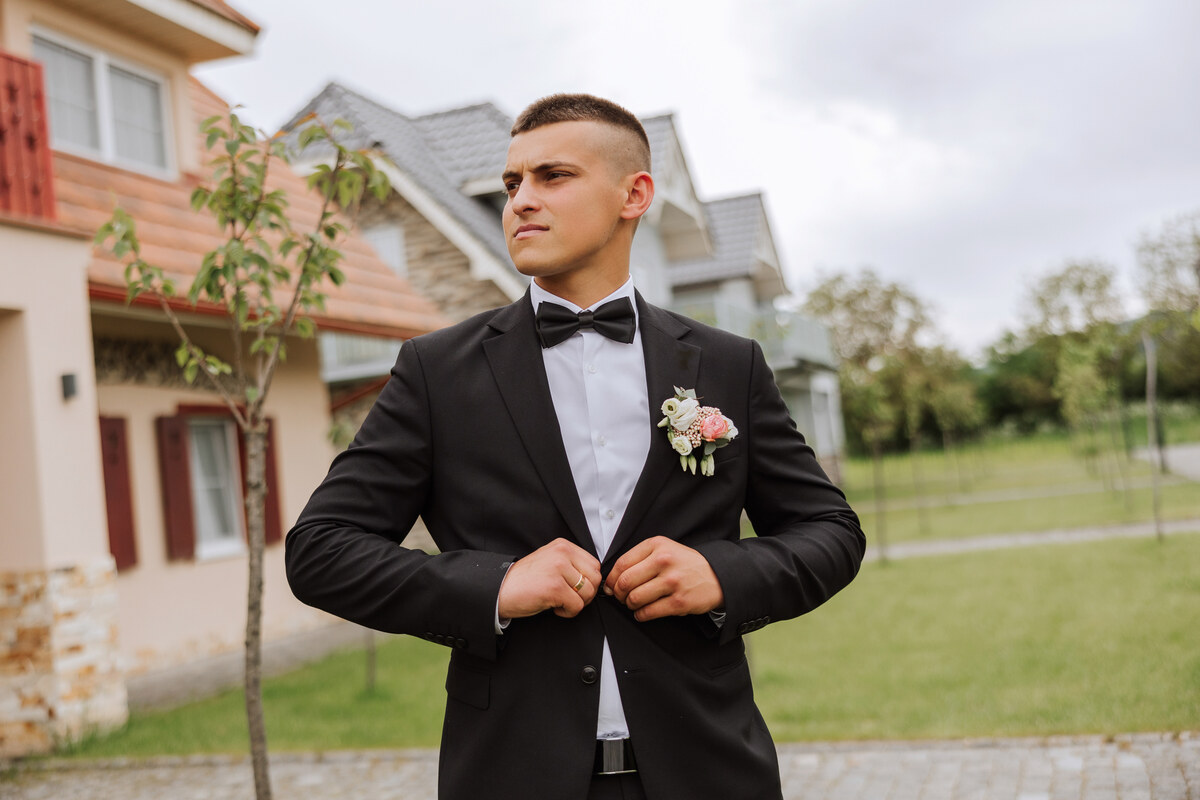
For couples who do want the full, traditional black tie formula, it comes with a specific recipe: satin or grosgrain lapels, matching trouser side-stripes, a white dress shirt with link cuffs, a black bow tie, an evening waistcoat or cummerbund, and black patent leather shoes. In Britain, small deviations from that formula, like colored socks or a non-black bow tie, are treated as a deliberate style statement rather than a mistake.
So wear the tuxedo if it is what makes your groom feel like himself. Just know that, technically, he would be in good company keeping things a little more relaxed too.