That thin sheet of tissue paper resting on top of your wedding invitation looks like pure elegance. It actually started as a practical fix for smudged ink, and it is only one of several little clues hidden in your stationery that tell the story of how couples have invited their loved ones over the centuries.
Before paper, there was the town crier
Long before anyone licked an envelope, weddings in England were usually announced by a town crier. He walked through the streets calling out the news of the day in a loud voice, and traditionally, anyone within earshot became part of the celebration.
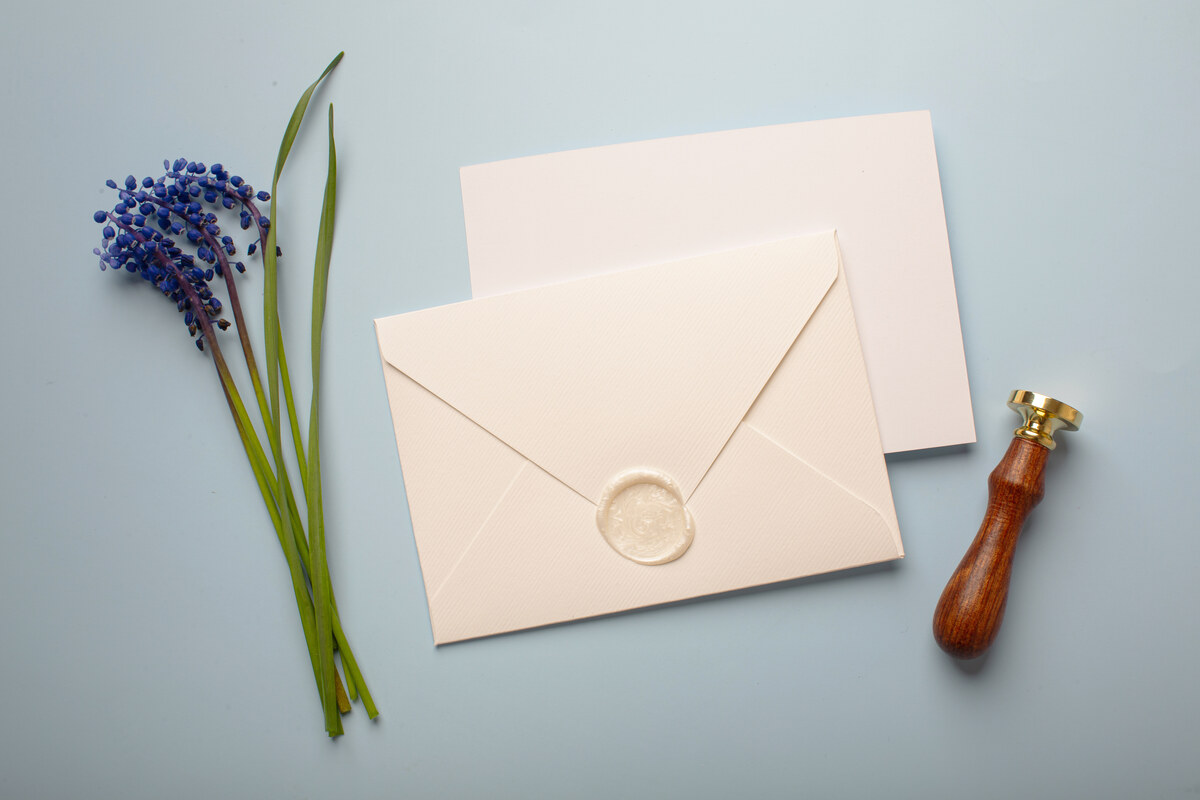
That changed slowly. In the Middle Ages, most ordinary people could not read, so written invitations first appeared among the nobility. Wealthy families asked monks skilled in calligraphy to craft their wedding notices by hand. These documents often carried the family coat of arms and were sealed with wax, a detail many couples still love to borrow today.
Why the tissue paper is really there
The printing press, invented by Gutenberg in 1447, did not immediately help. Early printing simply stamped ink onto paper with lead type, and the result was far too rough for a stylish invitation. What did catch on around this time was announcing weddings in the newspaper.
The real turning point came in 1642, when Ludwig von Siegen invented metal plate engraving. An artisan had to carve the text in reverse onto a metal plate, which was then used to print the invitation. To keep the fresh ink from smudging, a sheet of tissue paper was laid on top of each engraved card. Modern printing no longer needs that protection, so today the tissue is purely decorative. Many people who know its original purpose simply take it out.
Invitations back then were also more personal in one lovely way: the name of each guest was usually printed individually on the card.
The double envelope comes from the days of horseback delivery
In 1798, Alois Senefelder invented lithography, which made sharp, clean printing possible without engraving. For the first time, wedding invitations became something a wider market could buy.
Getting them to guests was another story. The postal system was still young and unreliable, so invitations were delivered by hand or on horseback. A second, outer envelope protected the invitation on its bumpy journey, and the habit has stayed with us long after the mail became dependable. Traditionally, the inner envelope may be lined and has no glue on its flap, while the outer one is sealed and addressed.
Printed stationery for everyone really took off after World War II, helped along by etiquette advisers such as Emily Post and Amy Vanderbilt, and by thermography, a cheaper process nicknamed “poor man’s engraving” that creates shiny raised lettering.
Letterpress and the spelling of honour
Letterpress is a favorite for invitations today, prized for the deep impression it leaves in thick paper. Funnily enough, that bite was never the original goal: letterpress was meant to barely kiss the paper and leave a flat print. The deep impression is a recent aesthetic choice that adds the pleasure of touch.
Wording carries its own history too. Some American invitations still spell it “honour”, even though that spelling is not used anywhere else in the United States. The habit goes back to a ruling by Emily Post in the 1920s. In the United Kingdom, “request the honour of your presence” is used for a ceremony in a house of worship, while “the pleasure of your company” is used when it takes place elsewhere.
What this means for your own invitations
The good news is that most of these traditions are now choices, not rules. Plenty of couples skip the inner envelope to save money, paper and postage, and a pocket fold can take its place. The tissue can stay for charm or go without anyone noticing.
A few timings are worth keeping in mind. Invitations are usually sent six to eight weeks before the wedding, with a little extra time for out of town or destination celebrations. Asking guests to reply at least two to three weeks ahead is common, and many couples request answers up to a month before the big day.
And if you are worried about putting pressure on loved ones, etiquette is reassuring here: a guest’s only real obligation is to reply promptly. Receiving a wedding invitation does not require anyone to attend or to send a gift. If you have the time, a handwritten invitation in your own hand is still considered the most correct of all, a sweet echo of those first calligraphed notices.