Long before save the date cards and wedding websites, the very first people to hear about your wedding would have been your whole parish. For centuries, couples had their names read aloud in church on three Sundays before they could marry, a custom known as the banns.
A public announcement with a purpose
The word banns (sometimes spelled bans) comes from a Middle English word meaning “proclamation”, with roots in Frankish and then Old French. The banns are the public announcement, in a parish church or at the town council, of an upcoming marriage between two named people.
It sounds romantic, and in a way it was, but the real purpose was practical. Reading the names aloud gave anyone in the community the chance to raise a legal or church impediment before the wedding took place. Typical reasons included an earlier marriage that had never been dissolved or annulled, a vow of celibacy, a lack of consent, or the couple being too closely related.
From a 1215 council to three consecutive Sundays
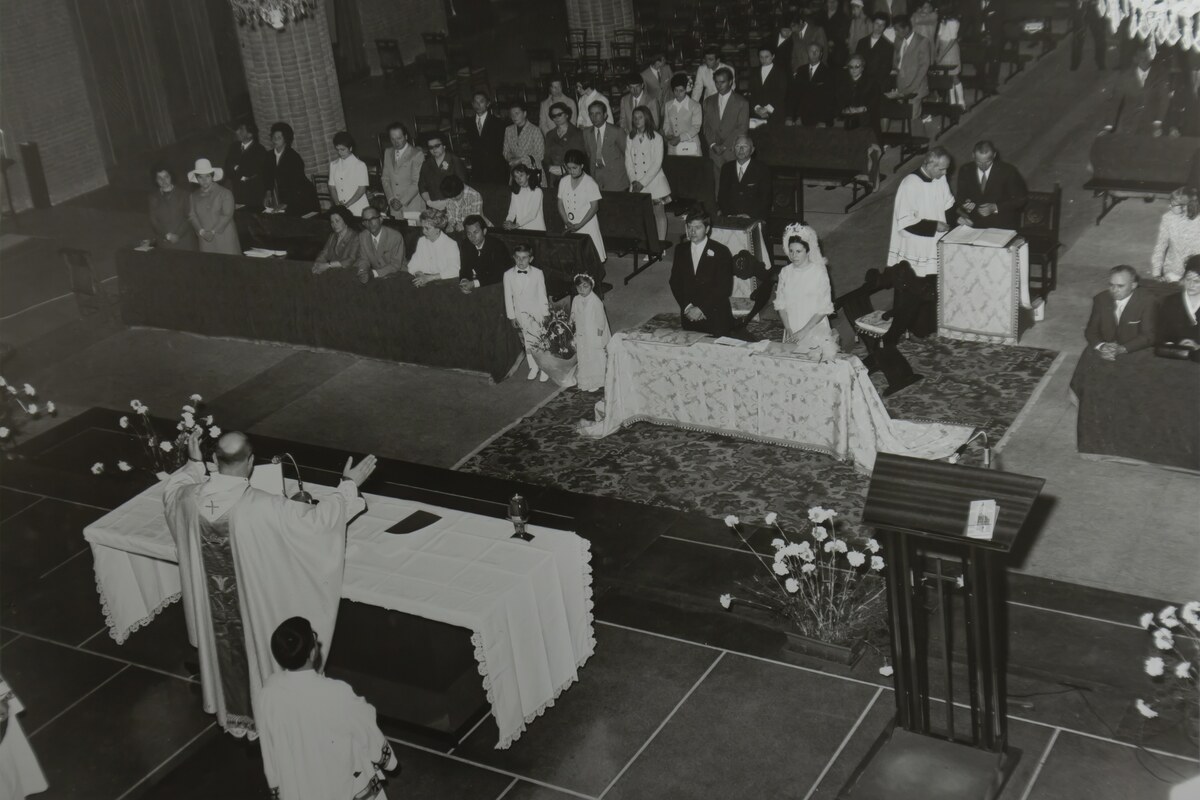
The Catholic rule dates back to Canon 51 of the Fourth Lateran Council in 1215, which aimed to prevent clandestine marriages. Before that, the announcement was only made in some areas. On 11 November 1563, the Council of Trent made things more precise: the names of the couple were to be announced publicly during Mass, by the parish priests of both partners, on three consecutive holy days.
The words spoken from the pulpit may sound familiar. In the Church of England’s Book of Common Prayer of 1662, the minister says: “If any of you know cause or just impediment why these two persons should not be joined in Holy Matrimony, ye are to declare it.” Each reading ends by noting whether it is the first, second or third “time of asking”.
In 1656, one parish register in Gloucester even records banns being “published by the Bellman”, the town crier. A lovely reminder that a wedding was once news for the whole town.
When skipping the banns could void a marriage
In England, the Clandestine Marriages Act of 1753 made the custom a matter of law. A marriage was only valid if the banns had been read on three Sundays in the home parishes of both partners, or if a marriage licence had been obtained. Without either, the marriage was void.
Licences themselves were not new. They had been introduced in the 14th century so couples could skip the usual waiting period, on payment of a fee and with a sworn declaration that nothing stood in the way of the marriage.
The custom crossed the Atlantic too. Plymouth Colony’s first marriage regulation, in 1636, required the banns to be read to the congregation three times, or posted publicly for fifteen days if there was no congregation nearby. Quakers were allowed to announce banns in their own meetinghouses. Over the 19th and 20th centuries, the practice faded in the United States as civil marriage licences took over the same role.
Where the banns still matter today
Banns are far from a museum piece. In the Church of England, they are still read on three Sundays, and since a 2012 update they must be published at the principal service. Couples can also hear the gentler modern wording from Common Worship (2000): “If any of you know any reason in law why they may not marry each other you are to declare it.”
In Ontario, Canada, the banns, proclaimed “openly in an audible voice during divine service”, remain a legal alternative to a marriage licence. The first few same-sex marriages in Ontario actually took place this way, because the province was not yet issuing them licences, and those marriages were ruled valid in 2003.
Elsewhere, the idea lives on in civil form. In France, the publication of banns is displayed at the town hall ten days before the wedding. In Finland, the legal requirement ended in 1988, but the Evangelical Lutheran Church still announces upcoming marriages unless the couple asks otherwise, a tradition known as kuulutukset. Germany required it until 1998, and the Netherlands still asks couples to register their intention beforehand, a step called ondertrouw.
A sweet tradition to borrow
If you are marrying in a parish that still reads the banns, consider making a small moment of it. You might enjoy sitting in the pews to hear your names called, with family beside you, on one of those three Sundays.
And if your wedding is entirely civil, the spirit of the banns is easy to keep: sharing your news openly with the people who matter, and letting your community celebrate with you well before the big day.