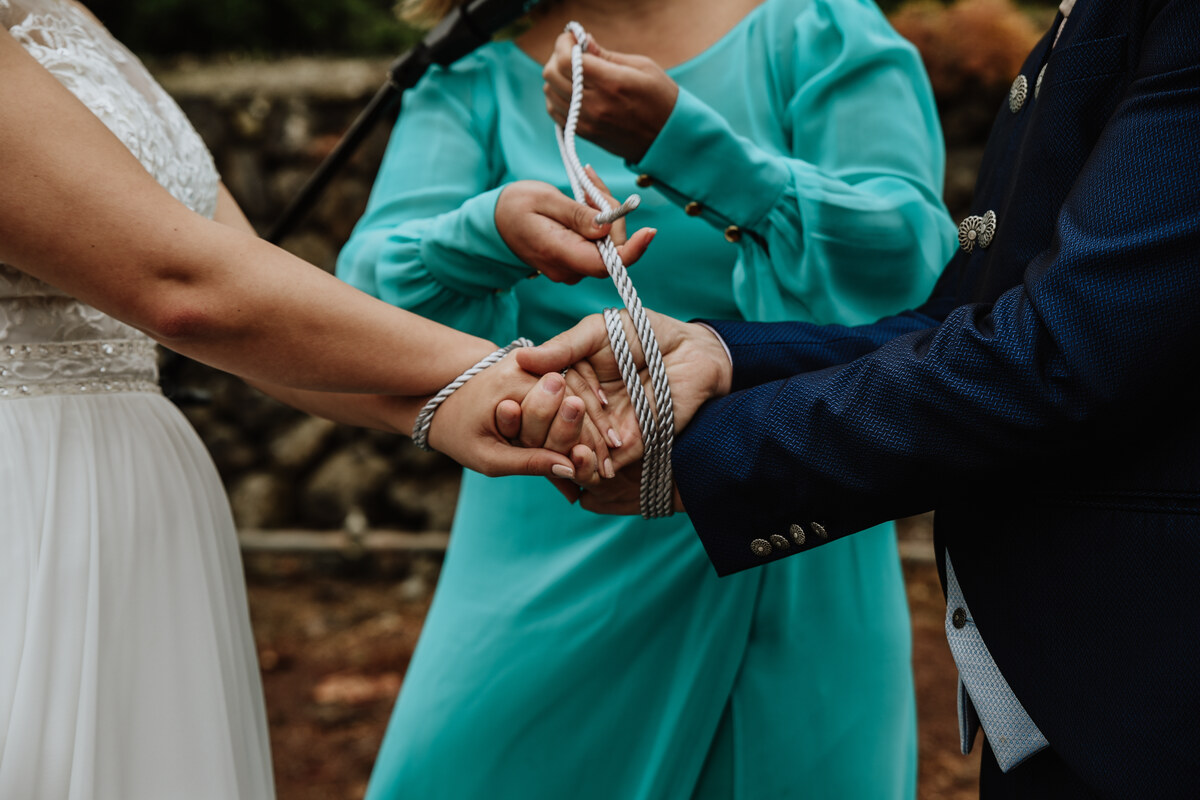
Many couples today choose a handfasting, wrapping their joined hands in ribbon as they say their vows. The gesture feels timeless, and in one sense it truly is: for roughly five centuries, joining hands and making a promise was enough to be married in England. The ribbon, though, is a much more recent addition.
A handshake that sealed a marriage
The word itself tells the story. To “handfast” meant to formally promise or make a contract, and the term was most likely borrowed from the Old Norse handfesta, to strike a bargain by joining hands. Similar words existed in Old Frisian and Middle Low German, and modern Dutch still uses “handvest” for a pact or charter.
From about the 12th to the 17th century, handfasting in England was the ceremony of engagement to be married, usually held about a month before the church wedding. But it was far more than a promise. As soon as the couple exchanged their vows, they were validly married, and English legal authorities held that a handfasting was as binding as any vow taken in church before a priest.
What a real handfasting looked like
The ritual was beautifully simple. The man and the woman, in turn, took each other by the right hand and declared aloud that they accepted each other as husband and wife. A traditional formula ran: “I take thee to my wedded husband/wife, till death us depart, and thereto I plight thee my troth.” That last phrase is why handfasting was also known in England as “troth-plight”.
Gifts were often exchanged, especially rings. A gold coin broken in half and shared between the couple was also common, and records mention gloves, a crimson ribbon tied in a knot, and even a silver toothpick. Handfastings happened almost anywhere: often in the bride’s home, but also in taverns, in an orchard, and even on horseback, usually with a credible witness present.
Even William Shakespeare took part in the custom. He negotiated and witnessed a handfasting in 1604, and historians speculate that his own marriage to Anne Hathaway in 1582 may have been conducted this way, as the practice was still accepted in Warwickshire at the time.
The ribbon is newer than the legend suggests
Here is the part wedding guides rarely mention. Gradually through the 17th century, English law came to require a priest or magistrate, and the 1753 Marriage Act effectively ended the custom in England. In Scotland, handfasting lingered as a recognised form of marriage until the Marriage (Scotland) Act 1939.
The ceremony many couples picture today, with hands wrapped together in cord or ribbon, has a different history. The term was adopted by modern neopagan and Wiccan weddings from at least the late 1960s, and reached mainstream weddings mostly in the early 2000s. The phrase “handfasting ribbon” only appears from around 2005, and by the 2010s commercial wedding organisers were offering the ceremony to everyone.
Along the way, it picked up a romantic label: an “ancient Celtic” or “pre-Christian” rite. Historians find that difficult to support. The word and the practice are most associated with Germanic peoples, including the English, the Norse and the Scots, and the famous Scottish “trial marriage for a year and a day” was itself doubted by the legal historian A. E. Anton in 1958, who traced much of its popularity to an 18th century travel account and a Walter Scott novel.
Why you can still make it your own
None of this makes a ribbon handfasting any less meaningful. If anything, the real history gives you more to work with. You could take each other by the right hand as couples once did, add a line of the old troth-plight words, or tie a single crimson ribbon in a knot, a token genuinely recorded in English handfastings.
Just skip the claim that your cord dates back to the druids. The true story, of couples promising themselves to each other in orchards, taverns and family parlours, hand in hand, is lovely enough on its own.